
The Dronningen came up the river to the inner Bristol wharf at the morning tide of the day after she had dropped her anchor at Bristol Roads. The pilot brought her up in February of 1877 at four knots under topsails with the tide and the wind on her quarter. The wharf at the inner port was a wharf of red-brick warehouses three storeys high and cobbled streets running back from the wharf-edge into the city, and the Bristol dock-men at the wharf-edge took the lines in the way Bristol dock-men took the lines for a Norwegian timber-bark in February.
The unloading began at noon.
The cord-wood came off the deck-cargo in lengths of thirty feet and twenty feet and twelve feet at four lighters to the wharf and twenty Bristol dock-men at the loading-fall. The coal came up out of the holds at the after pump and a steam-winch the Bristol yard had brought to the wharf for the discharge.
The unloading took six days.
Olav had the half-day shore-leave Tollefson gave the larboard watch on the second day at the inner wharf. He went up from the wharf to Marsh Street and along Marsh Street to the corner where Marsh Street met King Street, and at the corner he stood for some minutes and looked at the Bristol he had not seen before. Bristol in February of 1877 was a city of red brick and grey stone with a small rain falling at three o'clock in the afternoon and the smell of coal-smoke at every chimney, and the light in the rain was the light a Norwegian sailor of nineteen at his first English port had not yet seen.
He walked along King Street to the church at the end. The church was a grey-stone church the kind a Bristol parish kept up at the inner end of the working streets, and the church had a bell-tower with a single bell that rang at three for the afternoon prayers a few of the Bristol shopkeepers' wives had come up from their houses to attend. Olav stood at the lower end of the church-yard and watched the wives go in. He did not go in. He walked back along King Street to Marsh Street.
The cobbles at Marsh Street were wet. The rain was not the rain of a Stavanger February, which was a colder rain. The rain at Bristol was a milder rain that fell at a steady rate. The wharves at the inner port were three streets down from the corner. He could see the masts of the Dronningen between the red-brick warehouses at the lower end of Marsh Street.
Old Man James came up to him at the corner.
Old Man James was a Bristol man of about sixty in a black coat that had been a good black coat thirty years before and was now a working coat for a man who walked the wharves at Bristol giving tracts to the sailors of the foreign ships that came in, and he had a canvas bag at his shoulder with the tracts and a few bound books from the Religious Tract Society at his side. He saw Olav at the corner and he came up to him and he gave him a tract in Norwegian and one in Swedish and one in English, because Old Man James gave a sailor at a corner three tracts in the three languages of the Northern European trade and let the sailor decide which to read.
"You are off the Dronningen," Old Man James said.
"I am."
"Your captain is Tollefson."
"He is."
"Tollefson has been at Bristol three times before this voyage. He is a man I have given a tract to once and have not needed to give a tract to since, because Tollefson is a man who has the temperance pledge already. You will tell him from me that the Good Templars at Marsh Street will hold a meeting on the Wednesday evening at seven, and that the Templars will be glad of his ship's men if any of his ship's men want to come."
"Yes."
"Will you come."
"I will come."
"Good."
Old Man James did not walk on at once. He stood at the corner with Olav for a few seconds longer and looked at the Dronningen's masts at the lower end of Marsh Street.
"Your pilot prayed at the deck on the run up the Channel."
"He did."
"He prays at the deck on every Norwegian timber-bark he runs up the Channel after a hurricane. He has been a Bristol Channel pilot since eighteen forty-nine and he prayed on the Borgund in the hurricane of eighteen sixty-two and on the Lyngdal in the hurricane of eighteen sixty-nine, and the men of the Borgund and the Lyngdal told me he prayed in the way a Welsh Methodist prays at a deck after a hurricane that the ship has come through."
"Yes."
"You are a man whose ship came through. Tell the captain at the dinner at his cabin tonight, if the captain takes a dinner at his cabin tonight, that Old Man James said the pilot was the right pilot."
"I will tell him."
Old Man James walked on toward the wharf with the canvas bag at his shoulder. Olav put the three tracts in his coat-pocket and walked back to the wharf along Marsh Street.
The Good Templars Hall at Marsh Street was a hall of three storeys with a double door at the street and a sign at the door in English and Welsh and a lantern at the door that was lit in the evening from October to March. Olav came up to the hall on the Wednesday evening at twenty past seven with the tract Old Man James had given him in his coat-pocket and the half-crown the steward had advanced him at the noon meal. The hall was filling. There were perhaps a hundred meeting-goers at the benches and another twenty at the back of the hall standing, and the meeting-goers were Bristol dock-men and Bristol shopkeepers and the wives of Bristol shopkeepers and the sailors of three foreign ships at the wharf—two Swedish and a German and the Dronningen. Olav saw four of the Dronningen's men at the benches at the front. Bertel was at the third row from the front. Olav sat at the bench beside Bertel.
Old Man James was at the platform.
The meeting was the meeting of the Bristol Independent Order of Good Templars on the Wednesday evening of the first week of February in 1877. The Order's grand chaplain at Bristol gave the opening address. The choir sang the temperance hymns. A speaker from the Manchester lodge gave the address on the temperance pledge in the slow English of an industrial-Lancashire pietist. The collection was taken at the eight bells of the meeting. The meeting closed at half past nine with the Templars' benediction in English and a closing hymn the choir sang in two parts.
Olav sat at the bench beside Bertel through the meeting. He sang the hymns he could follow at the chord. He stood and sat with the meeting-goers. He took the tract the speaker from Manchester had brought down. He did not sign the temperance pledge because the Norwegian sailors at the Dronningen signed the temperance pledge only at the captain's word at his own ship and not at the word of a Bristol speaker at a Manchester lodge's tract.
The speaker from Manchester gave the address on the temperance pledge for the better part of an hour. The speaker was a man of about forty in a dark working-coat that had been brushed for the meeting, and he spoke in the slow English of a Lancashire pietist who had come down to Bristol for the winter at the invitation of the Bristol grand chaplain. He spoke about the small wages of the cotton-weaver at Manchester and about the cotton-weaver's wife and about the small things that went out of a Manchester house when the cotton-weaver took the second drink at the public-house at the end of the working week. Olav understood about half of what the speaker said. The Lancashire English was not the Stavanger English a Norwegian sailor learned at sea. He sat at the bench beside Bertel and listened to the half he understood and to the half he did not, and the speaker spoke in the manner of a man who had been at the temperance pledge for fifteen years.
He came out at half past nine with Bertel at his side.
The cobbles at Marsh Street were wet with the rain. Bertel said the meeting had been a meeting of the kind the Bristol Templars held in February, and that the meeting had been a good meeting if a man at the bench was a man who liked the Lancashire-English address. Olav said yes. Bertel said his wife at Tau had taken the temperance pledge in the year before her marriage, and that he had not signed it himself and had not been asked to sign it. Olav said he had understood that. They walked back to the boardinghouse along Marsh Street in the rain.
Olav decided to write the letter on the morning of the third day after the Templars' meeting.
He had thought about writing the letter on the evening after the meeting and had not written it. He had thought about it at the watches between the second morning and the third morning and had not written it, because the letter he was going to write to Olava from Bristol was a letter he had been going to write since the Christmas at sea between Wilmington and the storm, and the letter was a letter he had wanted to think about until the thinking was done before the writing began.
The thinking was done on the morning of the third day after the meeting.
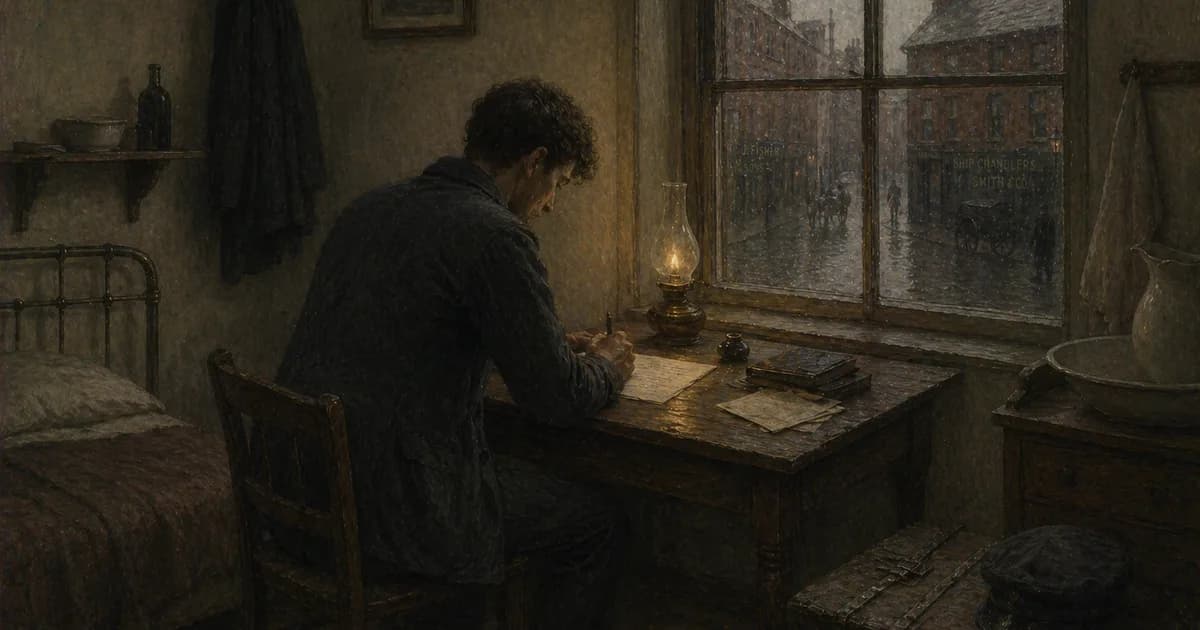
He went to the back room of the boardinghouse on Marsh Street at the noon hour with a sheet of the writing-paper the Swedish woman at the boardinghouse had given him from her own stock and the bottle of ink at the table beside the lamp. He sat down. He wrote the inscription at the top of the page in his own hand, which was the hand that had the small flourish at the y of Hestby that Olava had also at the y of her own name, and he had not noticed the flourish-of-the-y until Brinch had given him Olava's letter at Wilmington three months before.
The inscription was three lines.
To Olava Lindøy of Lindøy, in the parish of Hetland, by way of Bjørn Olsen Lindøy at Lindøy by way of John Stensøy at Stavanger.
Olav looked at the inscription for some minutes after he had written it. Then he wrote the date at the upper right of the page in the Norwegian numerals he had used since his confirmation, and the date was the eighth day of February in the year 1877.
He wrote the body of the letter slowly.
He wrote about the run from Wilmington and about the hurricane that the Dronningen had come through at thirty-eight north and thirty-five west, and about Tollefson at the wheel for sixteen hours on the fifth night, and about the new foregallant cap from Cardiff that had held. He wrote about Bertel making a small wooden box of teak with brass hinges for Birgit at Tau and stowing it in the locker at the foot of his bunk on the morning the glass had begun to fall, and about Erling at his first hurricane at the rail at the second night with the wind of the second night at his face. He wrote about Old Man James at Marsh Street and about the Good Templars Hall at the Wednesday evening meeting.
He wrote about her letter that he had read at the boardinghouse on Water Street at Wilmington in November, and about the long blue light at the small upper window at her room at Lindøy that she had told him about, and about the kind of light he had stood at the rail of the Dronningen at on certain nights of the run from Wilmington when the wind had been a fair wind and the watch had been a quiet watch.
He wrote the question.
He wrote it on its own line in the middle of the page, in a single sentence in the plain Norwegian a young man of nineteen at a Bristol boardinghouse-table on the eighth of February 1877 wrote to a young woman of nineteen at Lindøy:
Olava—will you have me as your husband when I come home from this voyage.
He looked at the line.
He had thought about the line for the three months between the writing of the letter at Wilmington and the writing of the letter at Bristol, and the line had been the one he had not yet been ready to write, and then the one he was ready to write at noon on the third day after the Wednesday evening at the Good Templars Hall. He had written it.
He did not write a question-mark at the end of the line. He had decided when he had thought about writing the letter at Wilmington that the question-mark was a thing he would not put at the end of the question, because the question was a question he wanted Olava to answer at her own pace and at her own house at Lindøy and the question-mark was a thing that pressed at the answering. The line had a full stop. The full stop was a small black mark at the page that did not press at her.
He wrote the rest of the letter under the line.
He wrote that the Dronningen would be at Cardiff in the third week of February for a loading and at Madeira in March and at Cape Verde in April for the southern leg, and that her letter—if she wrote a letter—should go to Cape Verde care of the Helland office at Stavanger and the Helland office would forward it. He wrote that he would carry her answer at his coat-pocket from Cape Verde wherever the Dronningen went after Cape Verde, and that he would carry it through the Atlantic and through the Caribbean and through whatever weather the Dronningen met, whether it was the answer he was asking for or the other answer.
He signed the letter Olav Hestby of Vestbø.
He folded it. He sealed it with the wax-stick the Swedish woman at the boardinghouse had given him from her own stock. He addressed the outside in the three-line inscription he had written at the top of the page. He laid the letter on the table at the back room.
He took the letter to the Helland agent at Bristol on the morning of the fourth day after the meeting. The Helland agent at Bristol was a Norwegian named Knudsen who handled the Stavanger shipping at Bristol and who had been at Bristol since 1862. Knudsen took the letter at the office at Queen Square. Knudsen said the Borre of Stavanger was leaving for Bergen at the morning tide of the fifth day and that the letter would go on the Borre. Olav thanked Knudsen. He went back to the Dronningen.
The Borre of Stavanger left Bristol at the morning tide of the fifth day.
Olav was at the foremast pin-rail at the morning tide. The Borre came down the river under topsails with the wind out of the southwest at six knots, and she passed the Dronningen at the inner wharf at half past seven and went down the river toward the Bristol Channel.
The letter was at her bag.