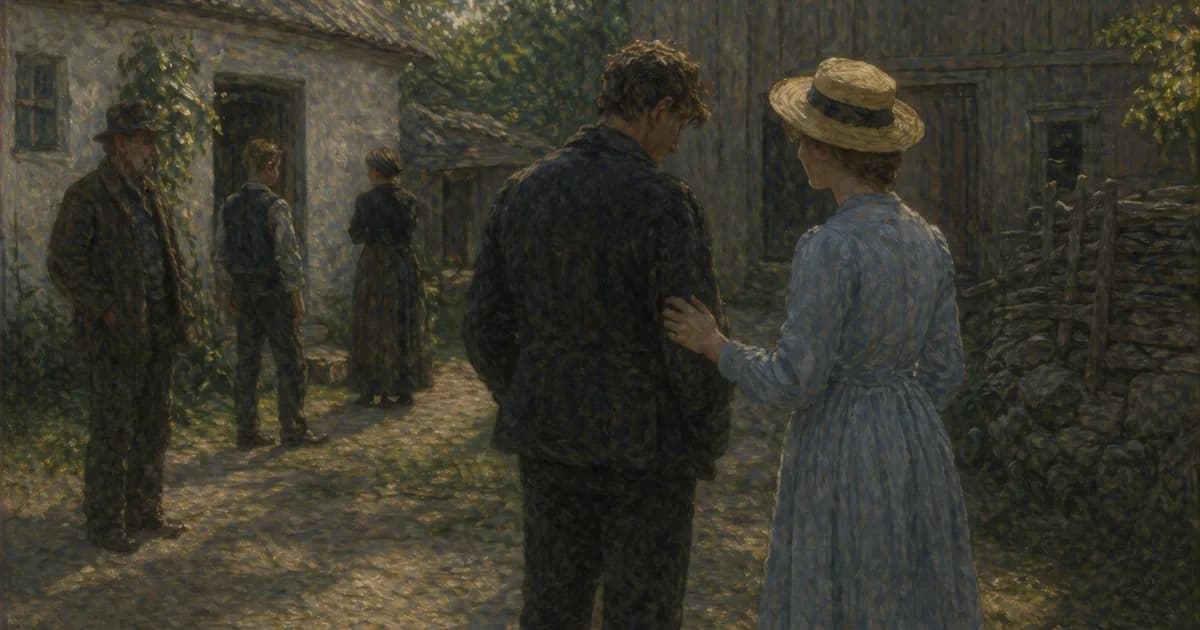

On the third Sunday of June Olav and Peder walked the road from Vestbø in the early morning. They wore their clean shirts and their clean coats and the boots they had cleaned the night before. The light came up behind them off the bay. The hawthorn at the lower gate had set its fruit and the petals had gone down into the verge, and the grass at the side of the road was the height of an old man's hand laid flat, and the air had the small heat of a June day getting ready to be warm.
They walked to Hesby first. The minister Lindbergen was at the pulpit in his black coat. The small window above the pulpit gave the same June light it had given two Sundays before. The pew across the aisle was empty. After the service Olav and Peder ate the bread the aunt had wrapped them at Vestbø, and they went south.
The road south from Hesby ran along the inside of the bay for a mile and then turned inland through the small valley above Østhusvik and came out again at the south end of the island where the Landa gaard sat above the strait with its two boatsheds at the water and its three houses set in a square at the head of the path that came up from the boats. The walk from Hesby to Landa was an hour and a quarter at the pace Olav and Peder walked it on a June Sunday with the morning behind them and the noon-meal at Landa ahead of them and the road dust not yet turned to summer dust by the July heat.
In the small valley above Østhusvik the road passed a stone wall that Jens had helped to lay in 1855 in the year before he had taken the plank to the knee at Hebburn. The wall had a cap of moss on it now. The stones at the bottom course were the gray stones of the upper-island, set the way a man sets a bottom course who has learned the laying from a man who knew the trade. Peder, who had been walking ahead of Olav at the pace of a sixteen-year-old going to a Sunday gathering, slowed at the wall and put his hand on it as he passed. He did not say what the wall was. He had not been told what the wall was. He walked on.
A little farther on the road bent inland and the bay went out of sight. They went up the small rise toward the gorse-fields above Østhusvik. Peder asked who would be at Landa. Olav said the young people of three islands. Peder asked, "Which three?" Olav said Finnøy and Lindøy and Stjernarøy, going by what the elder son of Lars had said at the Judaberg post. Peder asked if they would know any of the visitors from Lindøy. Olav said, "I do not know". Peder did not say more. They went over the rise and the road came down again toward the south end of the island, and they came up the path from the strait at half past twelve.
Landa at noon on the third Sunday of June was a gaard with thirty young people of three islands at the long tables in the courtyard and at the benches set out at the side of the largest of the houses. There was bread on the tables and there were dishes of cured pork and there were the mid-June plates of pickled herring and new butter and the soft cheese the women of the gaard had pressed the day before, and there was coffee at the iron pot at the far end of the courtyard. Olav and Peder gave their coats to the elder daughter of the gaard at the door of the largest house and were given a place at the table at the end nearest the path, and the elder daughter said the noon-meal was an hour off and that the young people of the gaard were at the small upper field above the courtyard playing tikken and would Olav and Peder care to go up.
Peder went up.
Olav stayed at the bench at the end of the courtyard for a moment and registered the gaard as a thing being lived at by thirty people and not by ten, and he registered the Stavanger dialect at the second table down from him. The visitors from Lindøy and from Roalsøy had been seated at the second table, and their voices had a southern cadence and a quickness Olav had not been at the table with before. He went up to the field.
The small upper field above the courtyard was the field the family at Landa had cleared for their lambing-pen and that was used in summer between lambings as the field for whatever the gaard's young people wanted to use it for, and on the third Sunday of June 1876 the young people of three islands were using it for tikken. There were perhaps eighteen of them. They had set the bounds at a line of small stones at one end and at the trunk of a single oak at the other and at the gorse at the side. The one who was it was a tall thin youngman from Stjernarøy whom Olav did not know, and the boys and girls were running in the way boys and girls run at tikken when the boys have decided not to slow up for the girls and the girls have decided not to be slowed up for. Peder, who was sixteen-and-a-half and had the legs of a boy who had walked the shore of the bay all spring, joined the run on the second pass.
Olav stood at the gorse on the inside of the field. He had played tikken last when he was thirteen. He watched.
A young woman in a light blue dress and a yellow straw hat ran past him at the third pass.
She was small. The straw hat came up to his shoulder. The blue of the dress was the blue of cornflowers. The yellow of the straw hat was the yellow of a hat dyed at home with onion-skin and not at the milliner. She had not seen him. She was running to escape the youngman from Stjernarøy who was the it, and she got to the oak just before he got her, and she touched the oak with her hand and laughed and turned and ran back into the field. Behind her, at the gorse-side a few paces back, came another woman a little older—the woman who had been at the table at the second-down with the Stavanger voices—running at a slower pace, because she was not sixteen and was not running to win the tikken but to be in the field with the younger one.
Olav watched the field for the next quarter of an hour. The light blue dress was at the oak. The light blue dress was at the line of small stones. The light blue dress was at the side of the field, hand on the gorse, breath caught, laughing at her companion. The yellow straw hat had come off her head once and she had put it back on without slowing.
Peder came past Olav on a pass and said, breathing, that the it had been changed and the new it was the elder son of Landa.
Olav nodded.
The new it was a boy of about seventeen who knew the field and who caught quickly. The pace went up. The young people in the field were laughing at the rate young people laugh when the catching has speeded and the running has speeded with it, and the young woman was running with her companion at the perimeter of the field, and Olav was at the gorse on the inside, watching.
The elder son of Landa caught her at the line of small stones. She put her hand on the stone in the way a runner who knows the bound puts her hand on it before the catcher gets there. The elder son got there a moment after, and she was it. She stood at the stone laughing and she put up the yellow straw hat with the back of her wrist, and she looked at the field. She looked round the field once. She stopped at Olav.
She had not seen him before.
She looked at him for a moment. Then she went after the youngman from Stjernarøy.
Olav looked at the place where she had been.
The bell at the gaard rang at one o'clock. The young people came in off the field. Peder came down from the upper end with the elder son of Landa beside him saying something Peder was laughing at. Olav came down from the gorse-side with his coat over his arm. They went into the courtyard by the path that ran along the south side of the field. The young woman in the blue dress was at the door of the largest house when they came in. She had taken off the yellow straw hat and was holding it in her hand. She was in conversation with her companion. She did not look up.
The noon-meal at Landa was at the long tables in the courtyard from one o'clock to three o'clock. There were a hundred people at it, counting the gaard's own household and the Lindøy and Roalsøy visitors and the young people of three islands and the old people of three islands. Olav sat at the bench at the end of the table he had been given. The man on his right was a farmer from Stjernarøy of about Jens's age whose son had been it at the tikken in the morning, and who said two things to Olav about the year's lambing on his island and after the second thing turned to the farmer on his right and did not speak to Olav again. The man on Olav's left was the elder son of the gaard at Roda, who said one thing to Olav about the road from Hesby and after the one thing turned to the woman on his left, who was the woman who had been at the table at the second-down with the Stavanger voices and who was now at this table because the seating had been changed for the meal. Olav ate the bread and the cured pork and the cabbage. The voice of the young woman was at the table down from him. He did not hear what she said to the woman beside her. He heard the rate at which she said it.
After the meal the older men sat at the long bench outside the largest house and the young people went down to the strait at the boatsheds. Peder went down with them. Olav went part of the way down and then stopped at the small bench above the boats and sat at it, because the bench was at a place from which a man could see both the strait and the courtyard above. The strait had three boats hauled up at the boatsheds and a fourth at the moorings out in the channel, where the visitors from Lindøy had brought it across that morning. The boys were at the boats and were turning the small Landa boat over to look at the new caulking, and Peder was among them.
The young woman in the blue dress came down the path from the courtyard with her companion at three o'clock and went out onto the long stone of the boat-landing. They stood at the stone for a few minutes and looked at the strait. The yellow straw hat was at the back of her head with the ribbons in front. Her companion said something to her at her shoulder. She looked up the path and saw Olav at the bench. She held the look a moment. Olav held it back. Then she said something to her companion that Olav could not hear, and her companion answered, and after a few minutes she and her companion turned and went back up the path to the courtyard.
Olav watched the strait for some time after they had gone. The water at the channel had the color the water had at three o'clock on a June Sunday with the wind off the south. He went back up to the courtyard at half past three.
The afternoon came on. The sun was south of west at five. The heat of the day went out of the courtyard at a quarter past five. The visitors from Lindøy and Roalsøy began to gather their things at the door of the largest house. Peder came to Olav at the bench at the courtyard and said the family at Landa had said they were welcome to stay to supper and that the elder son of Landa had said there would be more tikken in the lower field at half past six if they stayed, and Olav said no. He said it was a long walk back. Peder said yes. Peder went to thank the elder daughter of the gaard.
Olav stood at the courtyard. He had his coat on his arm. He looked at the path that came up from the strait and at the path that went north from the gaard toward the road that ran past Roda and back to Hesby. The light at the courtyard was the late-afternoon light of a June day that had been warm and was no longer warm, and the shadow of the largest house had come across the courtyard and lay across the bench at which the older men had been sitting.
He had been at Landa for six hours. He had spoken to perhaps eight people in the six hours, and one of the eight had been the elder daughter of the gaard at the door, and one had been the elder son of Roda at the bench at the noon-meal, and one had been the farmer from Stjernarøy with the son who had been it, and the rest had been Peder. The young woman in the blue dress had been across the courtyard from him at the meal and across the field from him at the morning and across the strait from him at the boatsheds at three, and he had not spoken to her, and she had not spoken to him.
A young woman in a light blue dress came running across the courtyard at half-pace.
She came from the door of the largest house, where she had given her coat back to the elder daughter of Landa. She was running at the pace of a young woman who was not running for tikken but for getting to the path before the path-walkers had got too far ahead, and the yellow straw hat was set on the back of her head with the ribbons trailing, and her companion was a few paces behind her and was carrying both her own basket and the smaller one that belonged to her.
She came up to Olav at the corner of the courtyard.
She put her hand on his arm.
The hand was at the inside of his upper arm, just above the elbow. Her fingers were small. The blue of the dress was the blue of cornflowers. The yellow of the straw hat was the yellow of onion-skin dye.
"Come, let's go," she said.
She had a Stavanger dialect that was not entirely a Stavanger dialect but that of an island near Stavanger that had married inland in the last generation. Her voice was lighter than her companion's voice had been when her companion had spoken at the noon table. The hand stayed at his arm.
Olav looked at her.
Her companion came up. Peder came up from the door of the largest house. The four of them stood at the corner of the courtyard for a moment with the late-afternoon light at the side of the gaard's largest house, and she kept her hand at Olav's arm, and Olav, who had not had a woman's hand at his arm at any place since his aunt had taken his hand at the kitchen door at his mother's burial when he was nine, did not move.
Peder did not say anything for a moment. Then Peder said, "We are walking back."
"Yes," she said. "Up the road. We are at Roda for the visit. We will go with you to Roda."
"Yes," Peder said.
"Yes," Olav said.
She took her hand off his arm.
The four of them turned at the corner of the courtyard. They went out through the gate.
The road from Landa to Roda was a north road. It went up from the gaard at the south end of Finnøy and crossed the small valley above Østhusvik and bent inland through the ravine above the bay before it came back out at Roda. The young woman walked at Peder's pace and at Olav's pace, which were the same pace because Peder had matched his pace to Olav's at the gate, and her companion walked a few steps behind because the path through the gate was narrow and four people did not walk easily abreast. The June evening came on at half past six in the latitude of Finnøy.
They went up the road.