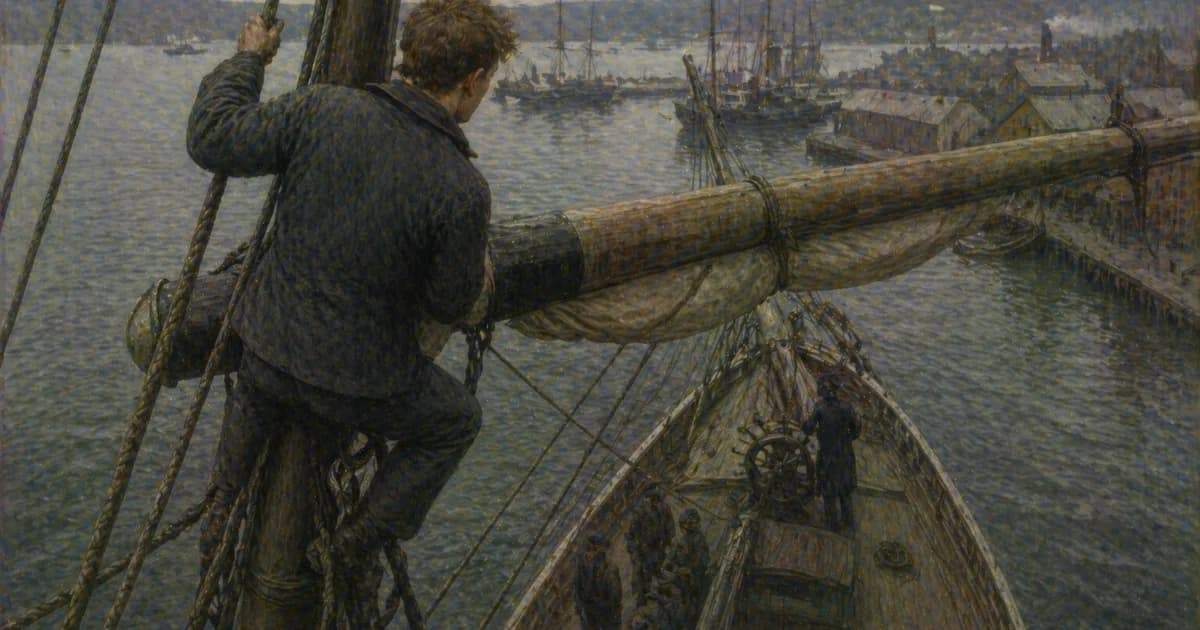

The captain came up from his cabin on the Tuesday after the dropping of the anchor and gave the order for the Asta to be warped in to the salt-wharf at Setúbal—which was a thing the captain could not give the order for because the Asta was at Lisbon and not at Setúbal, and the salt-wharf at Setúbal was forty miles south by the inside passage and a day's run with a fair wind, and the captain at the wheel-box at six bells of the morning watch in his coat with the wrong button back on the wrong hole gave the order anyway, and Lønning, who had the deck, said "Yes" in the voice Lønning had used for "Yes" since Palm Sunday morning, and went forward to the bow without looking at the captain again. The Portuguese harbor-pilot came aboard at noon. The pilot took the Asta out from the Lisbon anchorage at one o'clock and ran her down the inside passage in a wind that backed twice and held the third time, and by dusk the Asta was at the salt-wharf at Setúbal with her bow to the south and the salt-pans of the marshes behind the wharf running away in white squares to the limit of what Olav could see in the failing light. The salt-pans were a thing he had not seen anywhere before. The white had the color of a substance laid out by men in shallow trays so that the sun would do to it what the sun would not do to it in any harbor Olav had been to.
The salt came aboard the next morning.
It came in baskets carried by Portuguese stevedores who walked up the gangway in a line and tipped their baskets into the Asta's hold through the hatchway forward and walked back down the gangway in a line that did not pause at the rail. The stevedores were small dark men in cloth hats and rope-soled shoes who spoke to one another in the language of stevedores in the salt-trade at Setúbal and who did not speak to the Asta's crew because there was no business between a stevedore and a sailor that wanted a word said about it. The work went on through Wednesday and Thursday in the way salt-loading went on at any wharf where the salt was carried from the marshes onto the ship by basket and by stevedore. The captain stood at the after deck and watched. He gave one or two orders that were not orders Lønning had not already given. The crew worked with the stevedores at the hatch.
By Thursday evening the hold was three-quarters full and the Asta was riding low to her marks and the captain came forward with a piece of wood in his hand and stood at the hatch and said that the loading would continue on the deck.
Loading on the deck was a thing that was done at certain ports for certain cargoes and was not a thing that was done at Setúbal for salt because salt on the deck of a ship loaded with salt below would shift in any sea over a force-five and would put the ship on her side at the first weather she met outside the Tagus mouth. Lønning said this in the quiet voice of a first mate addressing a captain in the hearing of stevedores and crew. The captain said the loading would continue on the deck. Lønning said "Yes." The stevedores went on with their baskets. The salt came up onto the deck on the larboard side because the captain had said the deck and had said the larboard side, and by the change of the watch the deck on the larboard side had a knee-deep heap of salt running fifty feet from the foremast to the main, and the Asta was beginning to list to larboard at her mooring-lines.
The Portuguese stevedore who was the foreman came up to the captain at the rail at half past six in the evening and spoke a sentence in his own language that no man on the deck had to translate. The captain swung the piece of wood at the foreman's head. The foreman ducked the wood. The captain swung again and missed. The foreman stepped back to the gangway and said another sentence to the men behind him on the wharf, and the men on the wharf set down their baskets and picked up the boathooks that the wharf-watch kept stacked at the wharf-end for the unloading of the ships that needed unloading by force, and they came up the gangway with the boathooks raised, and the captain stepped back from the rail with the piece of wood in one hand and the other hand pressed to the heel of the first, where the chain had taken the skin off him on Palm Sunday morning and which had not yet healed.
Lønning said "Enough."
He said it in a voice none of the crew had heard from him in the four weeks since Stavanger. The Portuguese on the gangway stopped. The captain stopped. Lønning gave the order to the foreman in the foreman's own language—Lønning had spent two voyages in the Iberian trade as a younger man and had the salt-trade Portuguese to give an order with—to take the salt off the deck and put it back into the hold by way of the after hatch. The foreman gave the order back to his men. The men on the gangway set down their boathooks. They began to take the salt off the deck. The captain stood at the rail with the piece of wood in his hand long enough to understand that he had been countermanded in front of foreign labourers by his own first mate, and then he went aft, and went below, and shut the door of his cabin.
The salt came off the deck by midnight. The hold was full to the deck-beams. The hatch was battened. The Asta sat on her marks on a quiet Setúbal evening and the stevedores went home to wherever stevedores went home to and the crew went forward to the forecastle and the steward gave them a supper of bread and a fish stew without herbs because the steward had not had time to go to a market.
The captain did not come up on the Friday morning. He came up on the Friday afternoon at four bells, and the work he found Olav at was the work the captain ordered him to be at next.
He ordered Olav to the mizzenmasthead with a bucket of pork-grease.
The pork-grease in the bucket was the salt pork from the bottom of the ship's barrel that the steward had not been able to make a meal of in a month and that had begun to rot in its own brine and had been rendered down on the galley stove on Lønning's order so that the grease could be used for something. The captain had decided what the grease would be used for. He had decided it would grease the mizzenmasthead. The mizzenmasthead was the place at the top of the mizzen-mast where the topgallant-mast was stepped into the topmast and where the gear at the cap wanted slushing two or three times a year, which was a job that was done with proper slush from the galley, not with rendered rotten pork. Olav looked at the bucket. He looked at the captain. He took the bucket. He went up the mizzen.
The mizzen-mast on a three-masted schoonership ran to perhaps a hundred and thirty feet from the deck. Olav climbed the ratlines to the mizzen top and from the mizzen top up the topmast shrouds to the topmast cap and from the topmast cap up the topgallant rigging to the masthead. He carried the bucket on a sling at his shoulder and the smell of the rendered pork came up at him in the warm Setúbal afternoon in the way the smell of a thing that had been a man's food before it had become a thing that was not food came up at a man carrying it. He did not breathe through his nose for the last twenty feet.
He was at the masthead at the third bell of the afternoon watch with the bucket beside him and the small brush from the bucket in his hand. He began the work. Slushing the gear at the cap meant putting the grease on the iron of the cap and on the bands and on the cleats so that the iron would not seize and the wood would not check. He did the work. He had been at it perhaps twenty minutes when the wind freshened from the southwest and came across the Asta's mizzen at an angle that put a shake in the mizzen-topgallant which had been set in the morning to dry the canvas and which had not been taken in since.
He looked down. The captain had come forward from the wheel-box and was at the larboard fife-rail with the mizzen-topgallant brace in his hand. The captain was looking up. The captain hauled.
The yard he was sitting at the cap above was the mizzen-topgallant. With the wind on it, the canvas swung the yard against the cap when the yard was braced both ways. The captain braced the yard so that the canvas took the wind on the larboard side and then on the starboard side in succession, and the yard swung against the cap each time the canvas crossed, and the cap was the iron Olav was sitting against. The first swing did not throw him. The second swing did not throw him because he had got his arm around the topgallant-stay between the first and the second. The third swing did not throw him because by the third swing he had put both arms and a leg around the stay and was holding on the way a man holds onto what may keep him alive. He held the stay. The bucket of pork-grease had gone on the second swing and was at the deck somewhere. He had not seen it land.
The captain was at the larboard fife-rail still. The captain was looking up. The captain held the brace for the length of three more swings and then released it. The yard came back to its set. The mast was steady.
Haakon was at the foremast, and had been at the foremast since the captain's order to Olav had been given, and had not moved through the swings of the yard. Pål was at the main. Sørli was at the main. Lønning was on the after deck and had stood through the swings of the yard with his hand on the rail and his face composed, and had not given an order because the bracing had been the captain's. The captain went forward along the larboard rail to the foremast. He picked up a piece of rope from the pin—a heavy rope, the bitter end of a tackle-fall, three feet of it—and he came aft to the place under the mizzen where Olav was still on the cap. He swung the rope at Olav.
The rope was meant to come up at Olav and to take him at the foot or the leg, but the rope was not the proper weight for the swing the captain made and it had a knot at the bitter end that took the weight of the swing wide of where the captain meant it to go, and the rope came up at the mizzen-topgallant-stay and bounced off the stay and came back at the captain's own wrist with the speed of a thing thrown by its own weight. The captain dropped the rope. He held his wrist. He looked at his wrist. He went aft.
He did not look up at the masthead again.
Olav came down the mizzen at the change of the watch. Pål helped him onto the deck. Pål looked at his hands and said, "Wash them. The grease is rotten." Olav went aft to the wash-bucket and washed. The grease did not come off easily. He used the bar of yellow soap the steward kept at the bucket, and the grease came off slowly, and the smell stayed on his hands for the rest of the day. He stood at the rail and let the sun dry his hands. He thought about a thing he had not thought about in a long time and that came up at him now without having been called for, which was a face at a churchyard gate on a Sunday in March in another country, and the face was set down again before it had fully arrived, and Olav did not let the thinking go beyond the half-instant the face was there for, but the face had come up without being asked, and he understood, in a way he did not put into words for himself, that the work of not thinking about it was a piece of work he was going to be doing for a long time. He put his hands down. He went forward.
The next afternoon was the afternoon of his free watch.
A free watch on a ship at a salt-wharf in a foreign harbor was not a thing a sailor often had on a voyage, and the free watch came to Olav by the rotation of the watches and by the fact that the captain had not assigned him to any work between the four bells of the afternoon and the change of the watch at six. He was at the forecastle scuttle when the captain came forward at three bells and told him to take a bucket of tar and to tar the fore-rigging where the tar had begun to thin in the sun. The captain did not look at his own wrist when he gave the order. The wrist was wrapped in a strip of canvas the steward had cut for him and had bound on the night before. He did not look at Olav either. He gave the order at the deck-beam and went aft.
Olav got the bucket of tar from the locker at the forecastle scuttle. The tar was Stockholm tar in the bucket the steward had bought at the chandler at Stavanger and had marked with the steward's initials. He carried the bucket forward to the foremast. He set the bucket down on the deck at the foremast. He stood at the foremast for a moment with the bucket at his foot. Then he tipped the bucket over.
The tar came out onto the deck at the foremast in the slow black way tar came out of a bucket in warm weather, and it spread across the deck-planks at the foremast in a circle of perhaps four feet across, and it ran into the seam between the deck-planks at the larboard side of the circle and into the seam between the deck-planks at the starboard side, and it went on running in the seams for the slow second it took tar to find a place where it could stop running, and it stopped at the place where the planks were tight. Olav stood at the foremast and watched it stop.
The captain came forward at the run.
He came forward shouting in a voice that Olav had not heard from him before and that he understood, as the captain came forward, was the voice of a man who had gone past the place where his voice could threaten anything because the threat had been used up the day before at the mizzen-cap. The captain stopped at the place at the deck where the tar had stopped. He looked at the tar. He looked at Olav. He raised his hand. He did not bring his hand down. He stood at the place at the edge of the tar with his hand raised for the length of time it took a man to understand that the hand was not going to come down.
He turned. He went aft. He went below. He did not come up.
Lønning came forward at the change of the watch with a holystone and a bucket of sand. He set them at the place at the deck where the tar was. He said, "Get the tar off." He stood at the foremast for a moment without speaking. Then he said, "It will take you to midnight."
"Yes, sir."
"Take it to midnight. Then go to your bunk."
He went aft.
Olav got down on his knees at the foremast and began to scrape the tar off the deck-planks with the holystone and the sand. The tar in the seams would not come up easily. He worked at it through the dog-watches and into the first watch of the night with the sand turning black under the holystone and the holystone turning slowly to the color of a thing that had been dragged across tar for hours. The crew went forward to supper without looking at the place where he was working. Pål came up at one bell of the first watch and stood at the rail above him and said, "Slow on the seams. Hard on the planks. The seams take till morning if you do them right." Olav nodded. Pål went aft. The sun went down over the salt-pans behind the wharf. The lights of Setúbal were yellow at the wharf and white at the houses on the rise behind the wharf and were not the lights of Lisbon, which had been unlike the lights of any city Olav had seen, and yet they were of the same Iberian country and were its same yellow and white at a smaller scale. Olav worked. The bell sounded at midnight. He set the holystone in the bucket. He stood up. The deck where the tar had been was clean to the planks at the center and dark in the seams and would dry by the end of the next day to the color of a place a man had spent a night scrubbing.