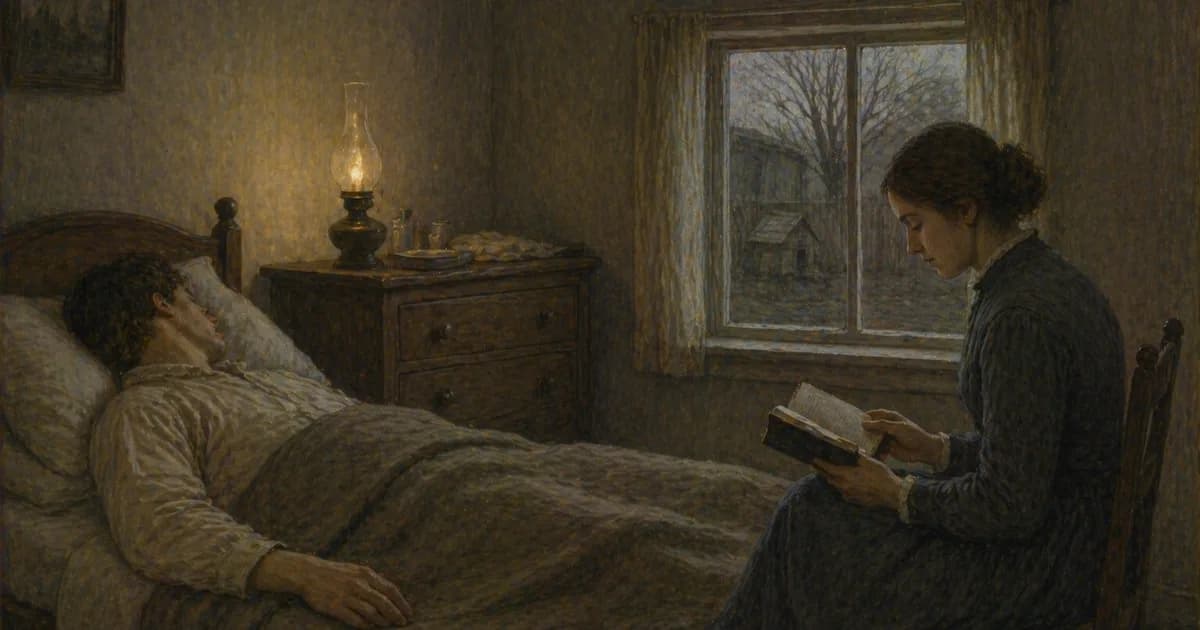

The fever held Olav at the back room of the O'Briens' house at Wilmington for the first week of his being there.
It was the typhoid fever the parish at Wilmington had been seeing in the upper city through the autumn of that year, which Father Donovan had named on the porch of the Catholic mission on the morning of the Saturday and which Patrick O'Brien had named again with the back of his hand at Olav's forehead at the chair at the fire that same morning. The fever was the kind of fever that came on hard at the second day and held a man at the bed for a week or for two and then broke at the morning of the eighth or the ninth or the tenth day, and a man came out at the breaking slowly, or did not come out at all. The parish had buried two through the autumn. Patrick had said as much to Mary at the kitchen on the morning of the second day when Olav had not eaten and the fever had been at its first crest, and Mary had said yes, and the two of them had not said it where Olav could hear them.
Olav did not remember the first week clearly.
He remembered the first morning at the bed and the small wooden cross at the window above. He remembered Mary at the bedside with the cool cloth at his forehead. He remembered Patrick coming into the room twice in the night with the lamp and standing at the door for a moment and going out again. He remembered Thomas at the folding-cot at the side of the bed for the first three nights and not for the nights after. He did not remember the fourth day or the fifth day. He remembered, at the seventh day or the eighth, a young woman at the bedside with a book at her lap.
Her name was Margit O'Brien.
She was the eldest daughter of Patrick and Mary O'Brien and was nineteen years old, which was the age of Olava at Lindøy that he had been told at the letter she had written him at Wilmington in November of the year before. She had her mother's brown hair pulled back at her neck and a white cap at her head the kind the daughters of the parish at Wilmington wore at the house, and she had a dark blue book at her lap that was bound at black leather, and she was reading.
She read in English.
She read in the slow English of a young woman of nineteen who had been at Wilmington since she had been six and whose English was the English her parents' Irish had become at the second generation. The book at her lap was the Imitation of Christ, which was the Thomas à Kempis the parish at Saint Mary's gave to the daughters of the parish at their first communion and which Margit had had at her own bedside for seven years.
Olav listened with his eyes closed.
He understood about half of the English. The half he did not understand was the meaning of the words. The half he did understand was the rhythm of the reading—the rise and the fall of a young woman's voice at a bedside.
He had been read to at a bedside before.
His mother had read to him from the gospel of John in the small back room at Vestbø when he had been at the small back room with the chest-cold of his sixth year, and that had been the spring before she had died at the spring of 1867. He had been read to in the Norwegian of the Vestbø pulpit. He had not understood the half of it then either. He had heard the rhythm of the reading and the rise and the fall.
The two readings were not the same reading.
The bed at the back room of the O'Briens' house was not the bed at the small back room at Vestbø. The book at Margit's lap was not the book his mother had read from. The English of Margit at the bedside was not the Norwegian of his mother. But the rise and the fall of the reading at a bedside was the rise and the fall of the reading at a bedside, and a man at a typhoid fever at the seventh day at Wilmington heard the rise and the fall of a reading at a bedside and knew it as a thing that had been a thing in his life before.
He opened his eyes once at the seventh day to look at her.
She did not look up from the book at the looking. She was reading the small Latin at the chapter heading the way a young woman of the parish read the small Latin at the chapter heading of the Imitation, which was without expecting the reader to know the Latin and without skipping it. Olav looked at her for a few seconds and closed his eyes again. She read on. He did not know the chapter she was at. He knew the rhythm.
The fever broke at the morning of the ninth day.
It broke in its own time. He woke at the morning of the ninth day with his head not the head it had been at the eight days before and with his back at the bed not the back it had been, and Mary came in at the morning with the cool cloth and the broth and registered the breaking at the cloth at his forehead and at the broth at his lips and went out and came back with Patrick. Patrick stood at the foot of the bed and looked at Olav. Patrick said: "You are with us." Olav said yes.
He sat up at the bed at the second day after the breaking.
Mary brought him a cup of warm milk with a piece of dark bread at the side. He ate the bread. He drank the milk. He sat at the bed at the wall and looked at the window above the chest of drawers. The window was a window that looked out at a back yard with a fence at the far side and the back of a frame house at the other side of the fence. The yard had a chicken-coop at the corner and a pear tree at the side of the coop that had no leaves at the November end, and the sky at the window was the grey sky of a Wilmington November coming into a Wilmington December.
Thomas had been working through the days of the fever.
He had taken a day-labor position at the wharves at the lower end of Wilmington at the eighth of November when Olav had been at the third day of the fever, and Patrick had given him the address of a wharf-foreman the parish knew at a smaller wharf to the south of the Dronningen's wharf, and Thomas had been at the smaller wharf at the loading of a Maine schooner and a New York schooner and a Bremen bark for the better part of three weeks. He came back to the O'Briens' house in the evenings with the day-wages at his pocket and gave half of the day-wages to Patrick at the kitchen table in the way a sailor between berths gave the day-wages to the household that kept him. Patrick took the half. Patrick had not asked for a half. Thomas had set the half. The two men had agreed on the half without much speaking about it.
Olav was at the bed for another four days after the breaking before he came down to the kitchen.
He came down on the morning of the fifth day after the breaking with his coat at his shoulders, which was the working coat he had worn on the foredeck for the eleven months out, and he sat at the wooden bench at the kitchen table with the broth Mary set down. Margit was at the kitchen with her mother at the bread. Margit looked at him at the bench. He said good morning to her in his English. She said good morning to him in her English. The two of them did not say more than that. Mary said the broth would do him good.
The November went into December.
Olav did the work of a man recovering from a typhoid fever at the back room of the O'Briens' house at Wilmington, which was the work of a man who came down to the kitchen for the meals and went out into the back yard for the air at the noon and read at the front room at the second hour of the afternoon when Patrick was at his work and Mary was at the back of the house and Thomas was at the wharves. The reading at the front room was from a Bible Patrick kept at the shelf and from the Stavanger newspaper Patrick had bought at the consul's office for him at the second week and from the Imitation Margit had given him at the third week without saying she had given it. He had thanked her for the Imitation without naming what the giving had been.
He did not write to Olava.
He had thought about writing the letter at the second week after the breaking. He had thought about writing it at the front-room writing-table where Patrick kept the bottle of ink. The letter to Olava at Lindøy would have to go through her father at Stavanger and the Helland office and the Norwegian shipping network, and the network would carry his place at Wilmington back to the Dronningen's owners and to the consul. He did not write.
She would not have a letter from him.
He carried Olava's two letters at the breast-pocket of the coat at the chair at the foot of the bed. He carried the thing wrapped in a piece of brown paper at the side-pocket. He carried the carte-de-visite at the wallet. He carried the bone-handled knife at the coat. The coat was at the chair at the foot of the bed at the back room of the O'Briens' house at Wilmington at the December of 1877.
Thomas brought the news of the Kvik on the evening of the second Tuesday of December.
He came in at the kitchen at the dinner with the news at his face. He said the Kvik of Drammen was at the inner wharf at the lower end and was loading a pine-board cargo for Hamburg, and the Kvik was leaving on the noon tide of Christmas Day for the run to Hamburg by way of the southerly Atlantic to the Bay of Biscay. He said the Kvik's captain was a Drammen man named Salvesen who was taking on hands at the wharf-edge for the Hamburg run and had taken on three already and was wanting two more. Thomas said the Kvik was not a clean ship and was not a fast ship and had been at sea for fifteen years and was not the bark a man signed on at any other time, but was the bark a man signed on at this time because she would not ask the questions a man at this time did not want asked.
Olav said yes.
Thomas said he would sign on the Kvik on the Friday at noon.
Olav said he would sign on with him.
Patrick at the head of the table looked at Olav for a moment and looked at Thomas. Patrick did not say anything at the looking. Mary at the side of the table looked at Olav. Margit at the side of her mother did not look up from the plate. The dinner went on without any of the four of them saying anything more about the Kvik for the rest of the dinner. Olav ate the bread that Mary had baked at the morning. He ate the piece of pork at the broth.
He went up to the back room after the dinner.
He sat at the bed for a few minutes. The lamp at the chest of drawers was lit at the low flame. The four objects at the pockets of the coat at the chair at the foot of the bed were at the pockets. The thing wrapped in a piece of brown paper was at the side-pocket. He laid his hand at the side-pocket. He did not take it out. He had not taken it out at the Sigrid and he had not taken it out at the Asta and he had not taken it out at the Dronningen and he had not taken it out at the chest at the bed at the back room of the O'Briens' house, and he did not take it out at the evening of the second Tuesday of December in 1877 at Wilmington either.
He laid his hand at the side-pocket for a moment and took it away.
Margit knocked at the door at the lamp.
She came in with a cup of warm milk on a wooden tray and a piece of dark bread at the side. She set the tray at the chest of drawers. She did not say anything about the Kvik. She said the milk was warm. Olav thanked her. She turned the lamp down a half-turn and went out of the room and closed the door behind her.
The milk was warm.
He drank it.
The Christmas approached at Wilmington in December of 1877.