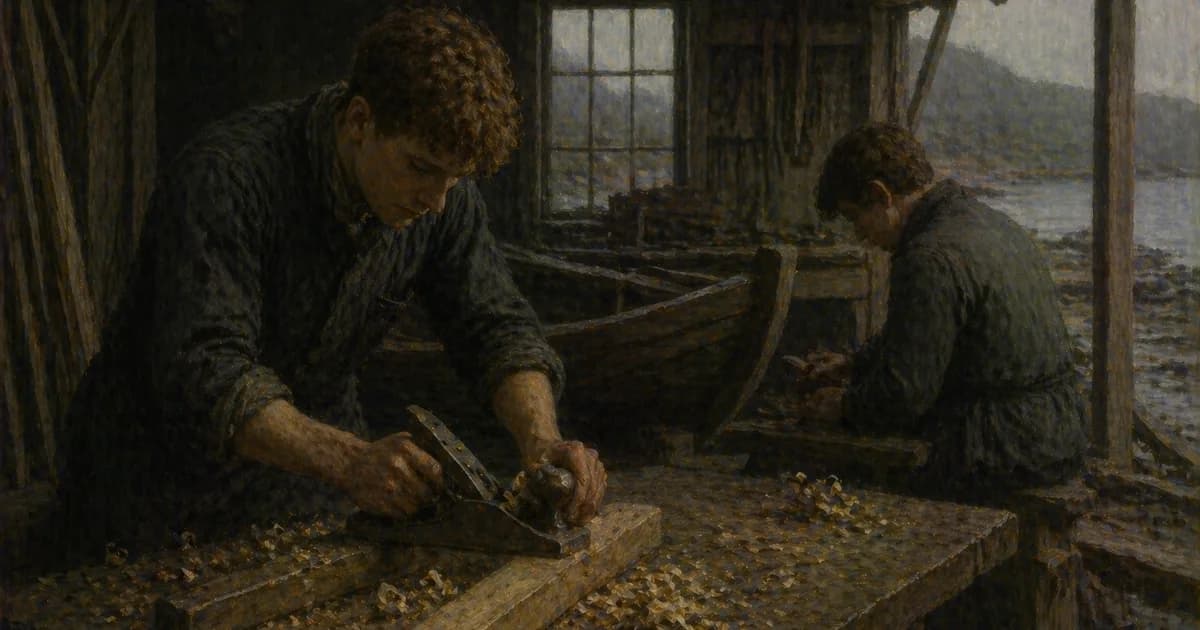

The two weeks between the articles and the sailing began with a boat-shed day. The rain was on the roof and Peder was running the plane down a length of pine his father had brought up from the landing the afternoon before. The plane was old and the iron had been set three times in Olav's memory. Peder held it at an angle Olav would not have held it at, and the shaving came clean. Olav had learned in six months at sea to know when a man had a tool in his own hand rather than his father's hand. Peder had the plane in his own hand. He had come into it over the winter while Olav had been beside him, and Olav had not noticed.
"The strake?" Olav said.
"The strake. Father said the summer after next. I said before summer and he said fine."
"He said fine."
"He said fine to the doing of it, not to the time of it."
"That is how he says fine."
Peder took another shaving. The shaving curled in the air and fell beside his boot. Their father had gone up to the house an hour before with his knee, and Peder had stayed in the shed and had begun the work as if his father's going had been the signal to begin, which perhaps it had been. Olav watched him for a few more strokes and then he took up the caulking iron and the small mallet and went to the other end of the boat.
They worked through the forenoon. The rain eased at eleven and stopped before twelve. The kitchen-chimney put out the smell of the midday bread, and Peder set the plane aside and ran his thumb along the new edge of the strake and said it would do, and Olav said it would do, and they went up to the house together.
There were twelve more days.
Olav took the cow out in the mornings and brought her back in the afternoons, because Peder had the boat and the barn-roof to finish and Jens was at the ledger or the line or at the small business of a man making accounts he would not be able to correct while his son was at sea. The bay was open past the stakes now. The ice had gone out in the last week of February and the water had the brown of early March at the estuary and the pale green of March-sea farther out. In the evenings the light held a little longer each day. On the fourth evening Olav sat on the stone step of the shed for a quarter of an hour after the supper, because he had not sat on the step for the whole of the winter, had not thought of sitting on it, and he was sitting now because there were twelve days and because a man stored what he could of a place before he went out of it.
On the sixth morning he took the cow up to the upper field where the grass was coming through in patches, and he stood at the stone wall at the top of the cart-track and looked down at the roof of the farm the way his father had looked down at it in February, though he had not known in February that his father had been standing at that wall on that morning. The fields above the house had not altered. The roof of the barn had not altered. The only thing that had altered was that he was going again.
On the tenth day he walked down to the landing after the supper had been cleared. The stones that would be under the boat on the morning of the sailing were the stones he had stood on in June and the stones he had stood on in December. He stood on them now. The tide was halfway. The water had the smell it had had in June, which was not the smell it had had in December. He watched the water for a long time, and then he went back up the path.
On the twelfth day he took his chest down from the loft above the bed.
It was the chest his aunt had packed for him in June. The lock had been the same lock since before his father had been born; the iron fittings had been replaced by a smith at Judaberg in the year Peder had been born. He set the chest on the floor beside his bed and opened it. He had not opened it fully since the morning after his homecoming, when he had put the knife and the Bible back into it on top of the folded shirts and had closed the lid without looking at what was underneath. What was underneath was the trousers he had not worn since August because they did not fit him any longer, and the seaman's cap his aunt had bought at the chandler at Stavanger because she had not known how such caps were made, which he had not worn either because a cap that did not sit right on a man's head did not get worn. He took the trousers out and set them on the bed. He took the cap out and set it beside them. He took the shirts his aunt had made him and held them for a moment—they had faded to the color of the water past the stakes—and he set them in a folded pile on the floor.
He packed differently this time.
He put the knife with the bone handle at the bottom of the chest, in the corner, in the leather roll his father had found in the drawer beside the accounts ledger and had given him after supper on the Monday without speaking. The roll held the knife and the sailor's needles and a small coil of waxed thread. He put the Bible in the corner opposite the knife, where a book would not slide when the chest was being carried. He put the pipe in the small cloth bag his aunt had sewn for him in the third week of January—she had heard from Jens about the Stavanger trip before he had heard it from Jens, because she had her own way of knowing—and he put the pipe and the pouch of tobacco and the match-box in the bag and set the bag on top of the Bible. He took two wool shirts that Peder had outgrown in the autumn and that the aunt had cleaned at Christmas, and set them in the chest with a pair of trousers of heavy black wool that had been his mother's brother's and had come to his father fifteen years ago and had sat in a second trunk in the loft since his father had stopped going to sea. The trousers had been out of the weather for twenty years and would stand the weather again.
He ran his fingers along the inside of the lid, where his grandfather's initials had been carved in shallow letters in the year of the chest's making and where his father's initials had been added beside them when his father had gone out in 1840. His own initials had been added in June with the same penknife his grandfather had used. The three sets of initials stood in the wood in a row the way three signatures stood in a registry. He did not think, now, that he had known what he was doing when he had carved his in June. He thought it anyway.
He looked at the chest with what he had put in it and he saw a man's chest and not a boy's. He thought it without pride, the way a man thinks about a wall that used to come to his shoulder and now comes to his chest, because the wall has not moved.
He closed the lid. He would add the oilskin his aunt was sewing in the week before he left, and the paper for letters Jens had ordered from Stavanger in the January letter that he had now guessed had been two letters, not one. There would be space for these.
On the Sunday morning of the second week the three of them walked the road to Hesby for the service.
The weather had turned fair. The road was wet in the shaded places and dry where the sun had been on it, and the ditches on the east side were running, and in the fields above the road the snow was gone except in the hollows where the wind had packed it hardest. They went in the order they had gone in January—Jens in front with his cane, Peder half a step behind Jens, Olav half a step behind Peder—and they did not speak on the walk.
The minister Lindbergen was at the pulpit in the same black coat. His spectacles had slipped the same small distance down his nose. His text was not the January text. His text was "lo, I am with you always" from the end of Matthew, which was a Sunday-before-Easter text, and he preached on it in his slow careful voice. Olav sat between Peder and his father. He sang the hymns he had known since his confirmation. In the pew across the aisle Karsten Tjørn was sitting with his mother again. Karsten was wearing a dark coat Olav had not seen before, and his hair had been cut since January—short enough that it no longer came down over his collar. He noticed. He did not know he had noticed until he had turned the page for the next hymn and had lost his place once, and had not lost it for any reason that lived in the book. His father gave him the page. He found it.
After the service the three of them went out with the rest.
They did not walk down to the churchyard gate the way the others were walking down to it. They walked along the side of the church to the stones, because that was what a family walked to on the last Sunday before a son went out, and Jens had not said that this was what they were going to do but it was understood. Gunnar Hestby's stone was at the east end of the row, against the wall. The stone had been cut in 1822, the year Gunnar had died at ninety-seven, and it had been cut by a mason at Stavanger whose hand had grown careful in old age, so that the name was deep in the granite and the dates were only a shade less deep. Gunnar had gone out in 1740 at fifteen on a Bergen brig and had come home at twenty-two with a hand that was missing the last joint of the ring finger on the right, and had farmed Vestbø for seventy years after that. Olav had known the stone all his life. He had stood at it at the age of six holding his father's hand. He had stood at it at eleven holding his own. Jens stood at it now without speaking for perhaps the length of a minute. Peder stood beside him. Olav stood a half-step behind. Then Jens said, "He went out at fifteen; Olav at eighteen; Peder will not," and he did not elaborate, and Olav did not know if the sentence was a prediction or a wish.
He looked at Peder. Peder had not heard the sentence, or had heard it and would not answer it. Olav did not ask him which. The three of them turned back toward the gate.
In the gate Karsten Tjørn passed them with his mother on his arm. Karsten did not nod this time. He looked at Olav and his face did not change, and the look held longer than it had held in the pew, and then he was past. His mother did not look at any of them. She was speaking to her son about a thing that was not a churchyard thing.
Olav walked home with his father and his brother in the same order they had come. He did not think, on the road, about the long look. He thought about the chest, and about Gunnar Hestby's seven years at sea, and about how many years lay between his own eighteen and whatever age he would be when he came home to stay. He would think about the long look later.
On the Tuesday after the service Olav walked into Judaberg for paper and for tobacco and for a small bottle of lamp-oil his father had been meaning to replace. The road ran six miles along the east side of Finnøy above the shore and then climbed the last half-mile inland to the town, which was three streets of frame houses and a stone chapel and a merchant's store that was the only building in Judaberg with a sign painted above its door. He went into the store. The man at the counter was a man of his father's age whose name was Isaksen and whose beard had been red in Olav's childhood and was red-with-grey now. Isaksen knew Olav by his father's name. He said the paper was a shilling and the tobacco was fourpence and the oil was another fourpence, and he gave Olav a small tin of the tobacco without the price on it, because he said a boy going out to sea at eighteen did not pay for the first tin of tobacco of his second voyage at this counter. Olav took the tin without arguing, because he had learned at the Sigrid's signing-in that a man did not refuse a thing that was given in a clean way by a man of his father's generation.
On the way back he passed two boys from school he had not seen since October—the Johansen brothers from Hagen farm—who were hauling a handcart of timber up the road and who lifted a hand without stopping. He returned the motion. He had been at school with the younger one. The older one he had not known well; the older one had gone to sea at fifteen and had come back after two voyages and had taken over the farm from a father who had broken his back in 1874. Olav watched the cart go past him and go on up the road toward Hagen, and he thought, as he walked the last three miles home alone, about the difference between a man who had been to sea twice and had come back to stay and a man who had been to sea twice and had not yet come back to stay.
In the last week his aunt came up from her house on the other side of the hill and brought him the oilskin she had sewn from a bolt of cloth she had bought at Judaberg in February. She did not knock at the kitchen door. She came in with the oilskin folded over her arm and she laid it across the back of a chair, and she said she had heard the ship was the Asta and she would pray for him. She kissed him on the forehead as she had kissed him in June. She took off her shawl and sat at the table and stayed for supper, which was potatoes and cured mutton and a small jar of preserved plums she had brought with her. She asked him if he was eating. He said he was eating. She asked Peder about the barn-roof; Peder said the barn-roof was done. She asked Jens about his knee; Jens said his knee was the knee it was. She said she would keep a light in her window on the Sunday nights until Olav came back. Nobody remarked on the promise. She went home before the light began to go, and Jens walked her up the road with the lantern as far as the church, as he had walked her on Christmas Eve.
On the Wednesday before the sailing Jens came down to the boat-shed and sat on the upturned bucket at the door. Peder had gone up to the fields. Olav was putting the last of the caulking into the small seam his father had been watching for a year. His father watched him for a time without speaking. Then his father said that he had sailed out of Stavanger in the March of 1840 on a ship whose name he had not thought of in thirty-five years and that had come back into his head this week, and that the ship had been a brig named the Freja, and that he had been a cook's-boy on her at sixteen, and that the captain had not been a hard man but had not been a kind one, and that the voyage had been five months, and that he had come home thinner and quieter and had gone out again in the September under a different captain. He said he had not told Olav this before because he had not thought Olav had wanted the telling. He said he was telling it now because Olav would hear a captain in April and another in August and the two would not be the same captain, and that the measure of a captain was not any one day of a captain but the difference of the day before from the day after.
Olav set the caulking iron down on the rail of the boat. He asked his father, because the question had been in him since Stavanger, whether the captain of the Freja had been the captain his father had sailed with for the whole of his sea time, or whether he had been one of a sequence.
His father said the Freja had been the first. He said he had sailed after her under men of various kinds, some hard and some not, and had come home at thirty-two in the summer the knee had happened. He said he had not, in any of those years, had on his shoulder the clap he had watched his son take on the Asta, and that he was speaking now not from having known Olav's captain but from having not known him and from having known others.
Olav did not say anything. He understood, in the silence of his father looking at his own hand on his own knee, that his father had said as much as he was able to say, and that this was the hour for it, and that there would not be another before the sailing.
"Yes," he said.
His father nodded once and did not speak again, and after a minute he got up from the bucket and went out of the shed and up to the house with the slight stiffness that had been in his knee all the winter and would be in it now until the spring was farther on.
On the Saturday evening Olav and Peder sat at the kitchen table after supper while Jens read by the fire. Peder had a length of rope between his hands and was working a small eye-splice into it the way Jens had taught him in January. Olav watched. Peder did the eye-splice well. He finished it and he held the splice up and he looked at Olav across the table.
"You will write."
"I will write."
"Not just from Lisbon."
"From wherever the ship is when she is at a place that sends post."
"And you will not hurt your knee."
Olav did not laugh; he smiled. "I will not hurt my knee."
Peder set the rope down and looked at the table for a moment. Then he said, "I did not ask you in January."
"You did not have to ask me in January."
"I asked Father what the letter had said."
"He did not tell me you had asked."
"He told me I was not to tell you I had asked. I am telling you now because I do not want to have asked and not said so."
"I did not think you had not asked."
Peder nodded. He took the rope up again and began to undo the splice to make it over. Olav watched him for a minute and then he got up and went out to the shed for the last time that evening and stood inside the open door and looked down at the landing. The tide was low. The stones that had been under the boat on the June morning were showing. Lars's boat was not at the landing yet; Lars would come in the morning before the light. Olav stood in the doorway until his feet were cold through his boots, and then he went back up to the house.
Peder was at the table still. The splice was done. Peder looked up once and did not speak, and Olav did not speak either, and they went up to bed together.