
The wind held from the northwest until the afternoon watch and then began to back.
The Asta was off Lista by then, with her courses and topsails set and the topgallants still in their gaskets, and the coast a dark line off the larboard bow that diminished by half-mile increments through the afternoon. Olav was at the foremast pin-rail with Nils. Anders Lønning, the first mate, had given them the order at four bells to overhaul the buntlines on the fore-course, and they had overhauled them once and were overhauling them a second time because the first overhaul had not pleased Lønning when he came forward to look. Lønning had looked at the buntlines, and he had looked at Nils, and he had said, in the quiet voice of a man who had taken Nils's measure at the muster and had not gone back on it, that the buntlines on a fore-course were not a thing a youngman could overhaul once and walk away from, and that he would come back at six bells. Then he had gone aft.
Nils had said nothing. He stood at the pin-rail with his hands on the line and his face turned away from the quarterdeck. Olav stood beside him and worked the line through his hands the way Haakon had shown him at the morning's first work, which was to feel for the place where the line had taken a set and to ease the set out before it became a turn. Olav was good at this. He had not been good at it on the Sigrid in June; he was good at it now because the Asta's lines were heavier than the Sigrid's and his hands had learned the difference. He worked. Nils worked beside him. Neither of them spoke.
Haakon came forward at five bells with the cat-falls coiled over his shoulder. He looked at the buntlines and he looked at Olav and at Nils and he said, "Lønning has gone below. You have until the eight bells to do them right. After that you have nothing to worry about."
"He said six bells," Nils said.
"He said six bells because he was angry. He will not come back at six bells. He will come back at eight bells because he will be at his coffee at six bells and the coffee at six bells of the afternoon is the coffee a first mate does not get up from. Do them right by eight."
He set the cat-falls down on the pin-rail and went aft. Nils watched him go. Then Nils turned to Olav and said, more quietly than he had said anything since they had crossed the bar at Tungenes, "Is he like that with everyone."
"He has been like that with me since Stavanger."
"He is like that with no one in Hogganvik."
Olav did not answer. Nils worked the line through his hands. The line needed to be worked through twice on a course this fresh and Olav had begun to see, in the way a man sees a fact about a ship in the first half-day under sail, that Nils would need to be told the things Haakon had told Olav at the morning's work because Haakon had had no time yet to tell Nils anything that was not the order for the next minute. Olav showed him the place to put his thumb. Nils put his thumb there. The line moved differently. Nils did not say anything but his face changed at the rail.
By eight bells the buntlines were right. Lønning came forward at eight bells and looked at them once and went aft without speaking. Nils let his breath out. Olav had not known he was holding his.
The watch changed at eight bells of the afternoon. The captain came up on the quarterdeck in his coat—the same dark coat he had worn at the dinner at the house in Stavanger, when he had been the man who had set down a glass and laughed at his own story about the Elida—and he stood at the wheel-box with his hands behind his back and looked aloft at the topsails and looked aft at the wake and said something to Karl Oberg that Olav did not hear. Karl Oberg said something back. The captain laughed. The laugh was not the laugh of the dinner.
Olav went below with Nils.
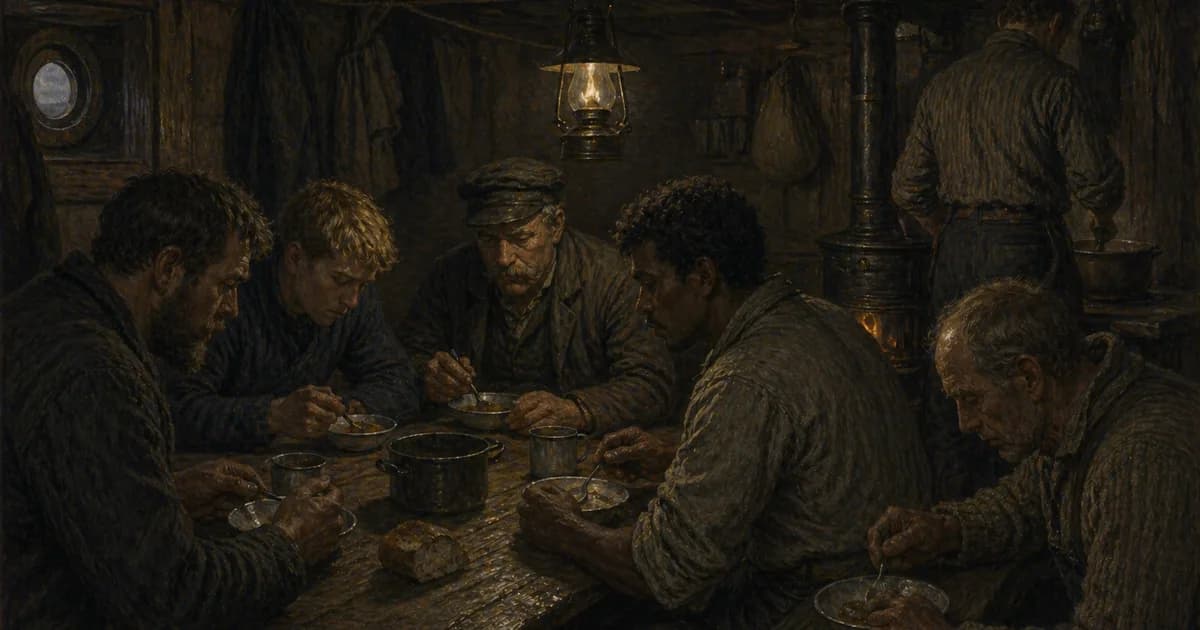
The forecastle was lit by a single lamp at the after bulkhead and the lamp was trimmed low because the steward was sparing of the oil. The men were at the table. Thompson was at the inboard end of the bench, his back against the curve of the hull, his long face down over a tin cup. Eliasson was beside him. Eliasson had the high color in his cheeks that had been the first thing Olav had seen of him at the muster, and he had a way of sitting at a table with his hands flat on the wood that Olav had not seen in another sailor. Beside Eliasson was the third sailor, a man called Sørli from somewhere east of Egersund, whose name Olav had heard at the muster and not until then, and who had said nothing to Olav in the day and a half since. The deckhand sat at the end. The deckhand was a man of perhaps forty whose name was Pål and who had sailed under the Stavanger ensign for twenty years on five ships and had the eyes of a man who had stopped expecting any one ship to be different from any other ship.
The steward was at the stove. The stove was the small black iron stove of a forecastle galley and the steward had a pot on it. Olav had not yet learned the steward's name. He knew only that the steward was from Flekkefjord, was thirty or thereabouts, had a black beard that was full enough to hide the lower half of his face, and had set out a row of tin plates on the table with the practiced motion of a man who had done it ten thousand times.
"Sit down," the steward said. He said it without turning from the stove.
Olav and Nils sat. Olav was at the outboard end opposite Thompson; Nils sat between Olav and Pål.
The steward brought the pot. He set it on a square of folded canvas in the middle of the table. He went back to the stove for the bread and brought it on a board. The bread was rye. The crust had the color of old pine bark. The steward set the board down. He cut the bread with a knife he kept on a peg above the stove, and he cut it the way a man cuts bread that has been in the locker a week longer than bread should be, which was to cut around the parts that had not held and to give each man a slice from the part that had. He gave Olav a slice. The slice had a soft place in the middle that was not soft from being fresh.
"It is what we have," the steward said, to no one in particular. "I told the captain at Stavanger we would want fresh in two weeks."
"What did the captain say," Eliasson said.
"He said we would have fresh at Shields."
"We will be at Shields in eight days," Sørli said, without inflection.
"We will," the steward said.
Pål said nothing. Pål ate his bread.
The steward gave them the meat from the pot. The meat had been cured in a way Olav had not seen on the Sigrid. Olav put a piece in his mouth and chewed and did not say what he was thinking. Eliasson, beside him, said quietly, "The mahogany side, or the horse side?"
"I do not know which is which," Olav said.
"You will," Eliasson said.
Thompson laughed once at the inboard end of the bench, a single short sound, and went back to his cup.
They ate for a time without speaking. Then the deckhand Pål said, in the voice of a man who was not asking and not telling, "He went into the steward's locker before sunset."
The steward stopped with his hand on the pot.
"Who," Eliasson said.
"The captain. I was at the after hatch coming up with the spare tackle and he was going down. He did not see me."
"What did he take."
"I do not know what he took. I know what he was going for."
The steward set the pot down on the canvas. He stood at the table for a moment with his hand still on the handle. Then he sat down on the bench beside Pål and took a piece of the bread off the board and ate it.
"He has been in the locker before," Sørli said. "On the Elida."
Pål nodded.
The steward did not say anything. He ate his bread. After a moment he got up and went back to the stove, and he stayed at the stove with his back to the table for the rest of the meal, and the men at the table ate the rest of the meat and the rest of the bread without speaking of the steward's locker again.
He had the middle watch. He went up at midnight and came down at four. In the four hours he was on deck the wind held, the Asta made her seven knots, the captain was below in the cabin with the lamp on, Lønning had the deck for the first half and Karl Oberg for the second, and the moon came up over the larboard quarter at a quarter past two and laid a path on the water that ran from the ship to the line of the horizon without breaking. Olav was at the bow for the half-hour before the moon came up because Haakon had sent him forward to overhaul the gear at the forecastle-head and to have a look at the bowsprit-shrouds where they had taken a chafe in the morning's work.
The figurehead was below him under the bowsprit. He had not yet looked at it from above; he had seen it from the quay at Stavanger and from the boat the morning of the boarding, and from those angles it had been a white shape with no face, looking forward at the water the way a figurehead looks forward at the water. From the forecastle-head, looking down, it was a different thing. He could see the back of the head and the line of the neck where the carving met the cutwater, and he could see, in the moonlight that had begun to come up before the moon itself was clear of the sea, that the carver had cut the back of the head with the same care he would have used if there had been a face on the front. The hair was carved. The set of the head on the neck was carved. Whoever had carved it had not stopped because there would be no face. He had finished the head as if there would be one.
Olav stood at the rail above it for a moment longer than he had been sent forward to stand. Then he turned to go aft.
Haakon was at the foremast.
"Done?"
"Done."
"Come."
They walked aft together along the starboard rail. The deck was empty between the foremast and the quarterdeck except for the man at the wheel, who was Karl Oberg, and the ship's boy who was bringing Karl Oberg his coffee. Haakon did not speak as they walked. At the main fife-rail he stopped and put his hand on a coil that had been laid down by the larboard watch and was not laid the way Haakon had laid the coils on the morning's work. He said, "Look."
Olav looked.
"You see it."
"I see it."
"Lay it again. Then go below. You have had a long day."
Olav knelt at the fife-rail and laid the coil the way Haakon had laid the coils that morning, in the figure-eight that did not foul itself when the line had to come off in a hurry. Haakon stood beside him while he did it. When Olav stood up, Haakon nodded once and walked aft.
Olav went below. The forecastle was dark except for the lamp at the after bulkhead, which was burning even lower than it had at supper. The men of the watch below were in their bunks. Nils was in the bunk across from Olav's. Olav climbed into his bunk and lay on his back. Above him the deck-beams were close enough that he could put his hand against them without straightening his arm.
He did not think, on his back in the bunk, about the steward's locker, or about the figurehead with no face, or about the captain's laugh on the quarterdeck at the change of the watch.
He thought about the line at the fife-rail.
He had laid it right.