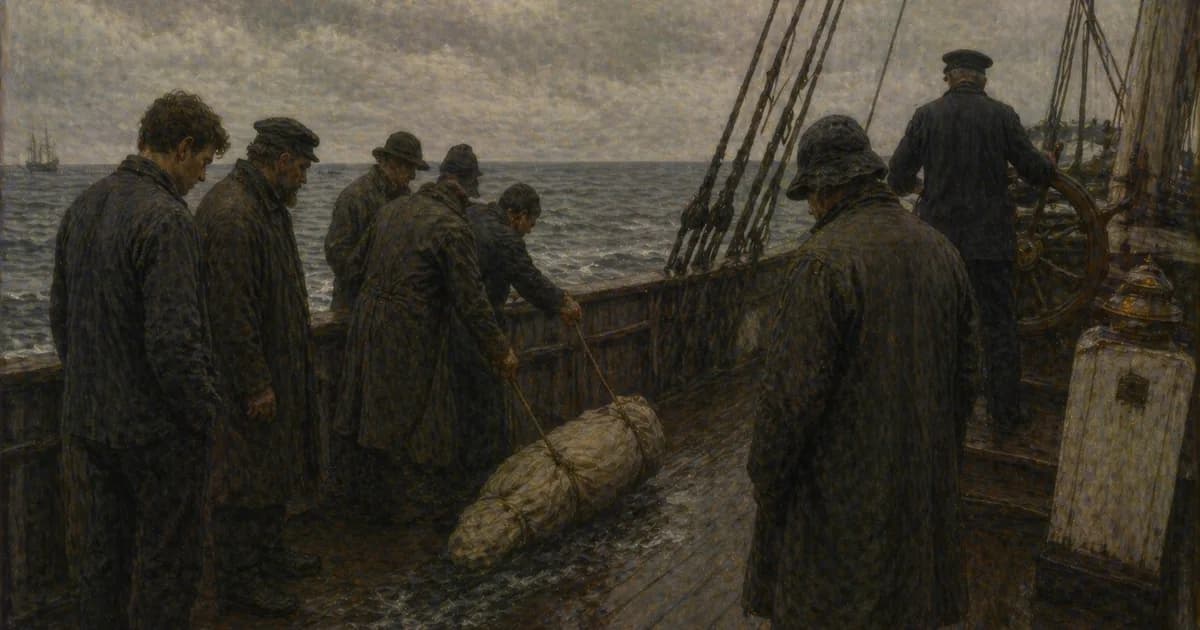

The wind backed into the southwest on the third day and held there.
By the morning of the fourth day the Asta had taken in her topgallants and was running under courses and topsails with one reef in the main, and the sea had begun to lift her stern in a way that was not the lift of a sea behind her but the lift of a sea building. Olav was at the foremast pin-rail in oilskins that had been a dead man's. Tønnesen out of Egersund had died ashore in January and the chest had been sold off at the chandler at Stavanger.
The captain had come up at four bells of the morning watch with the steward's locker on his breath. He had stood at the wheel-box without his coat and had given orders to Lønning that Lønning had carried forward to the watch without comment. Lønning's face under the oilskin hood had been put away for the day. Olav saw it and worked the line at the pin-rail and did not look at the quarterdeck again until the order to take in the upper topsail came down.
The order came at half past nine. The wind had freshened by then to what Haakon would have called a near-gale and what Lønning, when he came forward to give the order, called a piece of weather. The watch went up.
Olav went up with the foretop. Eliasson went up with the maintop. Nils stayed on deck because Lønning had told him to stay on deck, and the reason Lønning had told him to stay on deck was that the captain had come down the quarterdeck ladder when the order was given and had crossed the deck to the main fife-rail and had taken Nils by the front of his oilskin and had struck him twice with his closed fist, once on the side of the jaw and once high on the cheek. Nils had not raised his hands. The captain had let him go and had said something Olav could not hear over the wind. Then the captain had kicked Nils, once, in the place where a man's thigh meets his hip, and had walked back to the quarterdeck. Nils had stood at the fife-rail with one hand on the pin and had not put his hand to his face.
That had been the order to take in the upper topsail.
Olav reefed at the foretop and did not look across at the maintop while he was reefing. He did not see Eliasson go up the ratlines or take his place on the yard or pass the gasket the first time around. He saw the men on his own yard and he saw the canvas coming up under his hands and he heard the wind in the rigging and he heard, once, the voice of Karl Oberg from the deck calling something he could not make out. He came down the ratlines after the foretop was secured. Haakon was at the foot of the foremast. Haakon did not say anything. He looked once aft and once up at the mainmast and once at Olav and then he turned and went aft along the starboard rail.
Eliasson had fallen from the upper topsail yard.
Olav saw, when he had crossed to the main, that the men of the maintop were on the deck around something on the deck. Karl Oberg was kneeling. The captain had come down again from the quarterdeck. Lønning was standing a half-step behind the captain. Pål was at the head of the thing on the deck, holding his cap in his hand the way a man holds his cap when there is no other thing in his hand to hold. Olav crossed the last yard of the deck and looked.
Eliasson was on his back. His mittens were on his hands; the mittens were the brown wool mittens with the cuffs his mother had knitted him in the autumn and that Sørli had said were the warmest mittens on the Asta. He had gummed them with his breath in the cold and the wool had stiffened where the spit had frozen and then thawed and then frozen again. Olav saw the gumming on the mitten of his right hand because the right hand was the hand turned up. The other hand was under him. His legs were not arranged the way a man's legs were when a man was lying on his back. His forehead had a place above his right eye where the skin had opened and where the bone showed for a length of perhaps an inch. The anchor chain was inboard of where he had fallen. He had struck the chain on the way down. He had struck the deck after that.
He was breathing.
Karl Oberg said his name.
Eliasson's eyes were open. He looked at Karl Oberg and did not look at any of the other men. Karl Oberg said his name again. Eliasson moved his mouth. Karl Oberg leaned closer and put his ear to Eliasson's mouth.
"Please, captain, do not jerk my foot so hard."
Karl Oberg sat back. He looked at the captain. The captain did not say anything. The captain was at the head of the body, looking down. Eliasson did not say anything else. He breathed for perhaps another minute. Then he did not.
The captain turned and walked aft.
They put him on the half-deck under a tarpaulin while the steward brought up the canvas. The steward had also brought up two pieces of coal in a sack. Pål and Thompson sewed the canvas in the way Pål and Thompson had sewn canvas around men before. Olav had not seen this done. He stood at the rail and watched it. Haakon was beside him. Haakon did not speak. After a time Haakon said, "Get the tackle from the larboard cathead. We will need it for the lowering."
Olav got the tackle.
The burial was at noon. The wind had moderated by then to a whole-sail breeze and the sea was the high grey sea of the open water and the Asta was hove to with her main yards aback. The captain was at the helm. The captain steered the ship hove to himself, which was not a thing a captain did, and Lønning stood beside him without speaking. The crew were on the main deck. Karl Oberg stood at the head of the canvas and read from a small book he had brought up from his cabin, which was a book Olav had not known a second mate carried. He read in a quiet voice. He read four verses of a psalm and then he sang.
The hymn was Den signede dag. Karl Oberg sang the first verse alone in a voice that was a voice the men had not heard from him because they had not heard him sing. The voice was the voice of a man who had sung in a church choir for fifteen years before he had gone to sea. It carried over the wind. The men sang the second verse with him. They sang it the way a Stavanger crew sang a hymn at sea, which was to sing it without looking at one another. By the third verse Karl Oberg's face was wet. He sang the third verse anyway.
The lowering was Olav's, and Pål's, and Haakon's. They had the tackle from the larboard cathead and they had rigged it through the rail. The captain at the wheel watched the lowering. When the canvas was at the rail and the slack of the line came in and the body began to clear the deck, Olav was at the line nearest the rail and his hand was on the line at the place where the line had to be eased. He eased it. He eased it the way Haakon had shown him to ease a heavy load on a single fall. The body cleared the rail and went down and the sea took it without any sound that Olav could hear because the wind was in the rigging.
The captain shouted from the wheel.
He shouted, You lowered him like a cow, and he added a word that was not a word that was said in front of a captain's wife at a dinner table. He shouted it twice. The first time he shouted it across the deck at Olav. The second time he shouted it at the sea.
Olav heard, in the shouting, what the wife at the Stavanger table had been hearing.
He did not answer.
Karl Oberg shut his book. He stood at the rail for a moment longer and then he went aft. The watch dispersed. The body was gone. The captain put the helm up and the Asta came back onto her course south, and the main yards were braced and the topsails set, and by one o'clock the ship was making her seven knots again. Eliasson had been twenty-five. He was from a place called Kjølberg on the south side of the Lysefjord. He had a sister who lived at Førde and a mother who was alive at the place. The Lysefjord was a place where the mountains came down to the water and where the sun did not reach the bottom of the fjord between the middle of November and the middle of February. The mother would not know until a letter came.
The watch below was Olav's. He went below and he did not sleep. He lay in the bunk with his arm across his face and the sound of the Asta's timbers in his ears and the smell of the man who had owned the oilskin in the smell of his own skin. He thought about the gumming on the mitten. He thought about the bone showing above the eye. He thought about the way Karl Oberg's voice had carried in the third verse. He thought about a number of other things that were on the Asta with him. He did not think about a thing that was not on the Asta. There was a face he might have thought about, and he turned away from the thought before it had fully arrived, the way a man turns at the gate of a churchyard when his business is at the road and not at the stones. The face was not named. It was set down. He went to sleep with the face set down.