
At half past six on the Wednesday evening of the second week of July Olav put on his good coat at the small upper room at the third floor of the boardinghouse on Bredalmendingen. He had been at the boardinghouse for six days. The keeper had washed his shirt on the Tuesday morning. The shirt was clean. He went down the stairs at a quarter to seven, and the keeper at the writing-table at the foot of the stairs nodded to him as he went out, and he came out onto Bredalmendingen at ten to seven.
He walked to Bethania Hall.
He walked up Bredalmendingen to Pedersgate and up Pedersgate to Klubbgata, and the Stavanger streets at the long-light hour of a Wednesday evening in July were the streets of a coastal city at the close of the day's business, with the wharves below the town gone quiet and the meeting-goers of the various chapels walking in twos and threes toward the doors of their meetings. Olav passed two pietist women in dark dresses going up Klubbgata at the pace at which two pietist women in dark dresses went to a Wednesday meeting, and he passed a young man going up alone, and he passed a clerk in a brown coat coming down whom he had seen at the keeper's table at the boardinghouse on the Friday morning. The clerk did not see him. He came up Klubbgata to the cobbles at Bethania Hall at a quarter past seven.
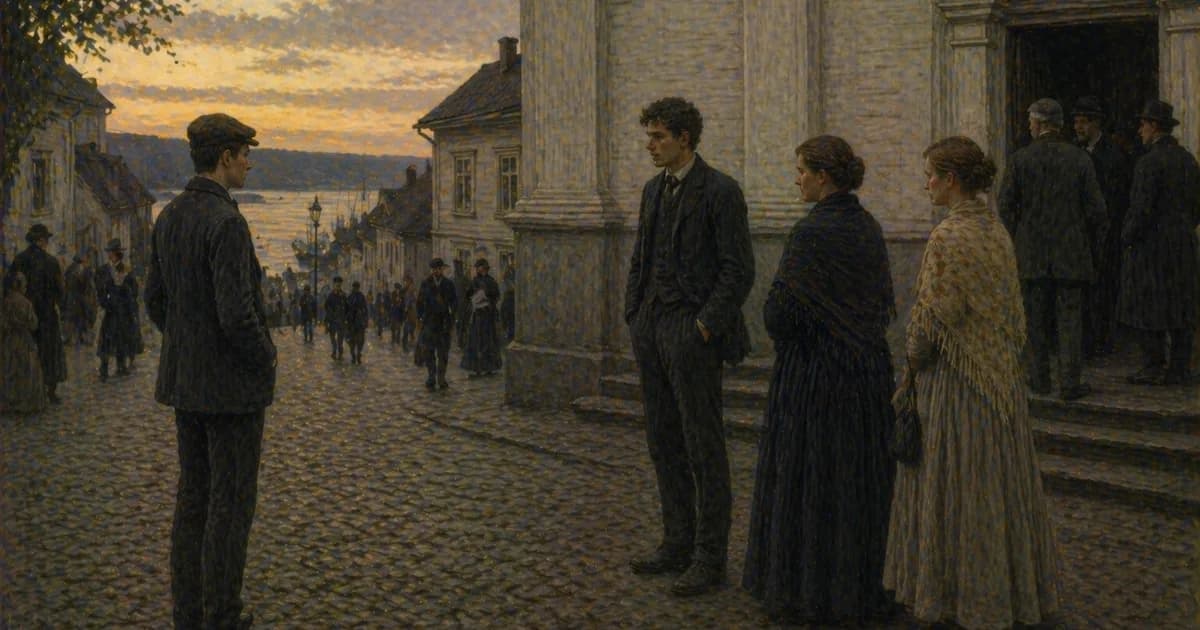
The hall was at the upper end of Klubbgata, a building of three storeys with a portico at the front and a square of cobbles before it where the meeting-goers gathered before the bell. Olav came up Klubbgata from Bredalmendingen at a quarter past seven and saw the cobbles already filling. There were forty or fifty people on the square, in clean coats and clean dresses and good shoes, and the talk on the square was the quiet talk of pietist meeting-goers at the door of a hall they had been at every Wednesday evening since the hall had opened. Olav stood at the edge of the square with his coat on and his hands at his sides and looked for Olava.
He did not see her at first. He saw the cousin from Rossøygate at the door of the hall, a tall woman in a dark dress with a white collar who had been at the side of the table at the dinner on the Saturday as the cousin of Bertha and the host of the long upstairs room with the window that looked down at the bay between Stavanger and the islands. She was speaking to a man Olav did not know. He did not see Olava beside her.
Then he saw Olava.
She was at the side of the cousin from Rossøygate, behind a group of meeting-goers who had been standing between her and Olav's view of the door, and she was wearing a dress Olav had not seen before—a dark blue dress with a white collar of the kind the cousin from Rossøygate was wearing—and a dark hat and not the yellow straw hat. She saw Olav at the edge of the square at the same moment Olav saw her. She did not raise her hand or wave. She nodded once at the cousin from Rossøygate, and the cousin from Rossøygate looked at Olav across the square and nodded.
Olav came up to the door.
"Good evening, Mrs," he said to the cousin from Rossøygate.
"Good evening, Olav Hestby."
"Good evening, Olava."
"Good evening, Olav."
The bell of the hall rang.
The three of them went in with the rest of the meeting-goers. The hall inside was a long room with rows of benches running from the back to a platform at the front and a pulpit at the center of the platform and an organ at the side and a door at the back of the platform that led to a room behind. There were tall windows along the side walls, and the evening light came in at the western windows, and at the eastern windows the light did not come in but the windows were open for the heat of the evening to go out. The hall held two hundred at the benches when it was full, and on the Wednesday evening of the second week of July it was filling. The smell at the hall was the smell of a Stavanger meeting-hall in summer, which was the smell of pine boards a long time used and the small smell of oil from the lamps that would be lit when the long light went, and on the air of the hall was the sound of the meeting-goers settling at the benches and the breath-sound of the choir going through the four hymns at the right of the platform.
The cousin from Rossøygate took a place at the seventh row from the front on the left side of the center aisle. Olava sat to her right. Olav sat to Olava's right because there was a place at her right at the bench where the cousin from Rossøygate had set them.
He sat down.
The hymn-board at the front of the hall had four numbers on it. The choir was at the right of the platform, twelve men and women in dark clothes with hymnbooks open. Mr Oftedal was at the pulpit in a dark coat and a white collar and a black neck-cloth, and he was looking at his notes at the pulpit and was not yet speaking. Olav looked at the pulpit. He looked at the choir. He looked at the people at the bench in front of him and at the people at the bench across the center aisle. He looked at the people at the benches behind him by turning his head a little.
Karsten Tjørn was at the third row from the back on the right side of the center aisle.
He was sitting beside an older man Olav did not know, possibly a relative of the family at Stavanger he had come to for the summer, and he was wearing the dark coat Olav had seen on him at Hesby church the Sunday before Easter. His hair had not been cut since the first Sunday of June. The hair came over the collar of the dark coat at the back of the neck where the dark coat met the shirt.
Olav turned his head back to the pulpit.
He did not look back across the rows.
He sat at the bench at the seventh row from the front on the left side of the center aisle with Olava at his left and the cousin from Rossøygate at Olava's left, and he kept his face at the pulpit. He knew without looking that Karsten was at the third row from the back on the right side of the center aisle. He knew it at his right shoulder, where the bench at his right was empty for two seats and the rows behind him were rows he could not see, and his right shoulder knew the rows behind him without seeing them the way it had known the deck of the Asta on the watches when he had been at the foremast pin-rail without looking aft.
The bell rang again.
Mr Oftedal began.
He preached on the eleventh chapter of the gospel of John, on the raising of Lazarus, in the slow plain Stavanger pietist voice that the meeting-goers had come up Klubbgata to hear. He preached for the better part of an hour. He read the eleventh chapter from the book at the pulpit and he gave the words plainly and without raising his voice. The choir sang the four hymns of the meeting between the prayers and the readings. Olav stood and sat with the meeting-goers at the times they stood and sat, and he opened the hymnbook at the pages the hymn-board had announced, and he sang the hymns he had known since his confirmation, and the singing of the hall around him was the singing of two hundred meeting-goers in a Stavanger pietist hall on a Wednesday evening in July. Olava sang at his left. The cousin from Rossøygate sang at her left. He did not hear what Karsten was singing because Karsten was twelve rows back and the singing of the rows between them filled the hall, but he knew Karsten was singing because the meeting was a meeting at which men did not stand silent at the hymns.
He kept his face at the pulpit through the preaching and at the hymn-board through the singing. He did not look back. At the third hymn the meeting-goers stood, and the standing-up of the rows behind him was the small movement at his right shoulder he had been registering through the meeting, and at the standing-up he registered Karsten standing without looking. Karsten stood with the meeting-goers. Karsten stood and Olav stood and the singing of the third hymn went on between them and around them and from them and from the rows in front of them and from the rows behind, and Olav did not look back.
The not-looking was a thing he did because the place and the time and the woman at his left required it of him, and the woman at his left was Olava, and the place was the place she had asked him to come to, and the time was the time she had asked him to come at. The not-looking was for her. He did the not-looking for her.
He knew Karsten was at the third row from the back. He did not look. He did the not-looking through the singing of the third hymn and through the closing prayer and through the bell at the end of the meeting, and at the bell he stood up with Olava and the cousin from Rossøygate, and the three of them went out by the center aisle.
They came out onto the cobbles.
The cobbles were lit by the long light of the July evening, which had not gone yet at half past nine, and the meeting-goers were coming out behind them and going off in twos and threes up Klubbgata and down toward the harbor, and Olav stood at the edge of the cobbles with Olava at his left and the cousin from Rossøygate at Olava's left, and he registered, in the way a man registers a thing he has been doing all evening, that the not-looking he had been doing was now a not-looking he could no longer do because the cobbles were a place where a man could see who had come out of the hall and where they were going.
Karsten Tjørn came out of the hall.
He came out as a man who had been at the third row from the back and who had stood and sat with the meeting-goers and who had come out at the close of a Wednesday evening meeting, and he stopped at the edge of the cobbles a few paces from Olav and Olava and the cousin from Rossøygate, and he looked at the long light at the upper end of Klubbgata where the cobbles ended, and he did not turn his head toward Olav.
Olava at his left was looking up Klubbgata toward the corner. The cousin from Rossøygate was speaking to a meeting-goer at her left about a matter that did not concern the cobbles.
Olav looked at Karsten.
He looked at him at the side, where he was standing a few paces away. He saw the dark coat. He saw the hand at the brim of the hat that Karsten was holding at his side. He saw the way Karsten was standing at the cobbles, which was the way a man stands who has been at a meeting and is at the door of the meeting and has not yet decided which way he will go down the cobbles.
Karsten turned his head.
He looked at Olav at the edge of the cobbles. He looked at him for the length of a moment two men can hold a look on the cobbles outside a meeting-hall. He did not raise his hand. He did not nod. He did not say good evening. He looked.
Olav did not raise his hand. He did not nod. He did not say good evening. He looked back.
The look went on at the rate the long light at Klubbgata went on at half past nine. It was the look that had been at the gate of Hesby churchyard on the Sunday before Easter, when Karsten had passed Olav with his mother on his arm and had not nodded, and had given Olav the look that had been a longer look than the pew had been. It was the look that had not ended at the gate of Hesby churchyard in March. It was the look the place and the time at the cobbles outside Bethania Hall on a Wednesday evening in July had given them the chance to end or not to end.
Neither of them ended it.
Neither of them spoke.
Karsten turned his head back to the upper end of Klubbgata, and he raised his hat at his side, and he set the hat on his head, and he went up Klubbgata without speaking to the man at the edge of the cobbles whom he had not spoken to since the gate of Hesby churchyard in March of the same year.
Olav watched him go. He watched until Karsten was at the upper end of Klubbgata at the corner where Klubbgata met the street that ran east toward the upper part of the town, and Karsten turned at the corner, and Karsten was gone.
The cousin from Rossøygate said it was time to walk back to Rossøygate.
Olav and Olava and the cousin from Rossøygate walked down Klubbgata to Bredalmendingen, and at Bredalmendingen Olav stopped at the corner because the boardinghouse was at the lower end of Bredalmendingen and Rossøygate was at the upper end, and Olava and the cousin from Rossøygate were going up Bredalmendingen and Olav was going down.
"Goodnight, Olav," Olava said.
"Goodnight, Olava."
"Goodnight, Mrs."
"Goodnight, Olav Hestby."
Olava and the cousin from Rossøygate walked up Bredalmendingen toward Rossøygate. Olav stood at the corner of Klubbgata and Bredalmendingen and watched them until they were at the corner of Pedersgate and Bredalmendingen, and they turned up at Pedersgate, and they were gone.
He walked down Bredalmendingen to the boardinghouse.
The light at Bredalmendingen at the close of a Wednesday evening in July at the latitude of Stavanger was the long light of the second week of July, which had not gone yet, and would not go for an hour more.
He went in.
The keeper was at the writing-table at the foot of the stairs. She did not say anything. He nodded to her. He went up the stairs to the second floor and up the third-floor stair to the small upper room he had been sleeping in for the seven nights of his stay. He took off the good coat and laid it on the chair by the window. He sat at the edge of the bed.
The light at the small upper window was the long light of a July evening at Stavanger.
He looked at the window for a moment. He did not light the lamp. He laid down on the bed.
He thought about the next voyage. The next voyage was three weeks off and the ship had not yet been signed. He thought about Olava at Roda. He thought about his father at Vestbø.
He slept.