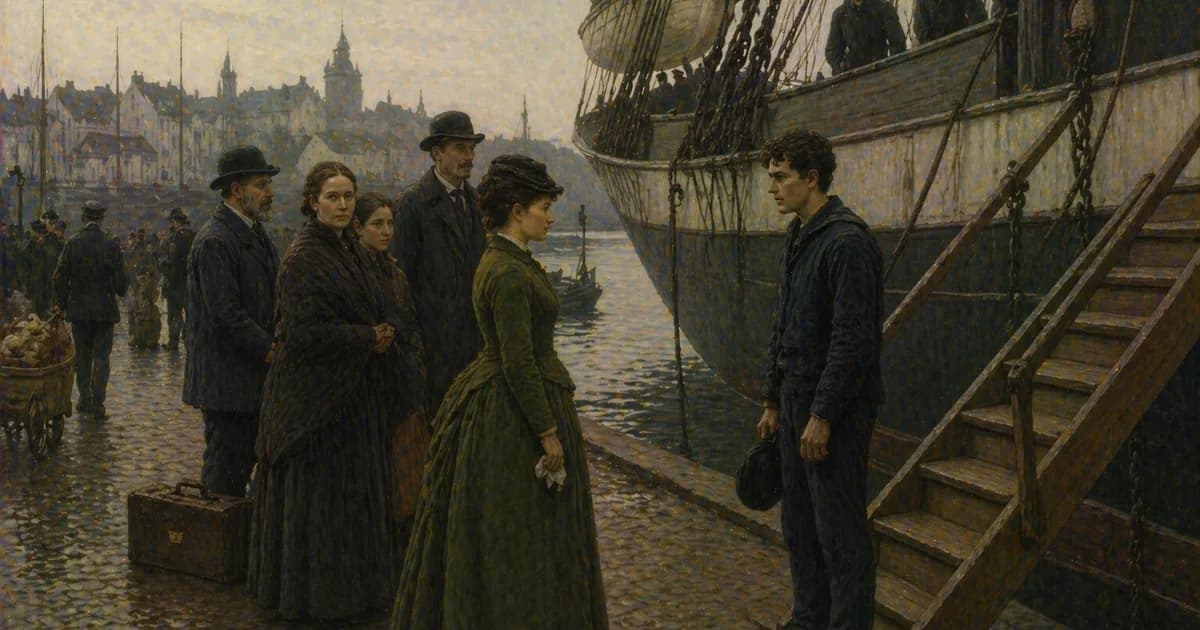

The morning of the day Olav was to go out a third time came up clear at Vestbø.
He had packed the chest the evening before with the aunt at the foot of the bed at the small upper room, and the chest had taken the things a man took with him on a voyage of eighteen months which were not the things a man took on a voyage of seven weeks. The aunt had folded two new wool shirts she had finished that week. She had folded a cap. She had folded a second pair of trousers. She had laid the leather roll his father had given him in the spring of the Asta on top of the trousers. She had laid the oilskin that had been Tønnesen's at the bottom of the chest with the spare blanket because the oilskin had been with the chest at sea before. She had not asked about the small thing wrapped in a piece of brown paper that was at the side of the spare blanket, because the small thing had been at the side of the spare blanket since May, and the aunt was a woman who had registered it and had not asked.
The envelope from the studio at Pedersgate had gone in last. Olav had laid it at the top of the chest, between the second pair of trousers and the leather roll, where the chest's own dampness would not get to it.
He came down the stairs before the light at four o'clock. The kitchen was dark. He laid the lamp on the table and lit it. The aunt had gone home over the hill on the night before; Jens was up in his own room dressing; Peder was still in the loft. Olav stood in the kitchen for a moment with his hand at the table. The cloth was the spring cloth. The table was the table. He took the bread from the board at the side of the stove and cut three slices and laid them on the plate, and he set the kettle on the stove for the coffee.
Jens came down at twenty past four. Peder came down at half past. The three of them sat at the table for the quarter of an hour it took them to eat the bread and drink the coffee, and they did not speak through the breakfast, because the breakfast had been eaten at this table by these three men on the morning before a long voyage only twice before—once in the year of the Sigrid and once in the spring of the Asta—and the third was not a thing that wanted speech over it.
Lars came up to the door at five.
"The wind is northwest by north," Lars said. "We will be at the inner pier by ten."
"Good," Jens said.
They went down to the landing.
The chest was at the boat with Lars. Peder did not come down to the boat. He stood at the door of the kitchen with his cap in his hand, and he watched his father and his brother and Lars go down the path, and he raised his hand at the place where the path turned, and Olav raised his hand back, and then Peder was at the door of the kitchen and Olav was at the boat with his father.
Lars rowed them across.
The wind was light at the bay and held northwest by north as Lars had said, and the bay at five in the morning of a clear July day at the latitude of Finnøy was a bay with the long light of a Norwegian summer morning on the water. Olav sat at the stern with his hand at the gunwale beside Lars's hand on the tiller. Jens stood amidships with his cane. He did not speak. The boat moved across the bay at the rate Lars rowed it, which was the rate of a man who had been rowing this bay for forty years and who knew how to row a man across when the man was going out a third time. Halfway across, Jens said to no one, in the voice he had used in March at the same place, that the wind would back into the west by the afternoon and that the ship would have her run out by then. Lars nodded without looking. Olav did not say yes.
Stavanger came up out of the water at half past nine.
The mast-forest at the inner pier had shifted again. Two of the bark-ships that had been at anchor in the spring were gone. Three brigs Olav had not seen before were at the inner pier. The Dronningen was at the herring quay with her yards crossed and her topsails loose and her men on the deck moving the way men moved on a ship that would take her wind in two hours. She was a bark. She was older than the Asta and her timbers were oak from Bremerhaven, and she sat at the quay the way a ship sat that had been built for the Australian passenger trade and that had been put to the European trade for the second half of her life. Her name was painted at her stern in white letters. Olav saw the letters from Lars's boat as they came up the harbor. Dronningen of Stavanger.
Lars set them down at the inner pier. Olav and Jens went up the plank with the chest between them, Olav at the upper end and Jens at the lower, and the order at the plank was the order of the March departure reversed not at all because Olav was again the man going aboard.
The office of John Stensøy was at the corner of Skagenkaien and Skagen, in a small white building with two windows on the ground floor and a single window above. The sign at the door said Stensøy & Heling, Agents and Owners. Olav had been at the door once before in March. He went in with his father and the chest at the door. Stensøy was at the desk inside.
"Olav."
"Cousin."
"Sit down."
They sat down. Stensøy had the articles ready on the desk. He read them aloud in the voice of a man who had read articles to his cousin's son three times in a year. Olav stood when the reading was done and gave his full name and the day and the year of his baptism and the place of his baptism, which was Hesby church on Finnøy, and Stensøy wrote these down, and Olav signed below the last line.
Olav Hestby of the farm Vestbø, Finnøy, in the parish of Hesby, the first day of April in the year eighteen hundred and fifty-seven. Able seaman, term of the voyage not to exceed twenty calendar months. Wage of sixteen kroner per month, with an advance of eight kroner paid on the day of signing.
Stensøy laid the eight kroner on the desk. He slid them to Olav. Olav put them in his pocket.
"Captain Tollefson is on the deck," Stensøy said. "I have spoken with him about you. He will give you the bunk that suits a man who has been on the Asta under his cousin's husband. You will not need to tell him what kind of man you are."
"No, sir."
"Go."
Olav and Jens took the chest down to the quay. They walked along the inner pier and up the herring quay to the gangway of the Dronningen. The men on the deck were bringing down the last of the dunnage from the after hold, and the cabin boy was coming up the gangway with a small basket of bread for the captain's table. Olav set the chest at the foot of the gangway. Jens did not go up the gangway. Olav held out his hand. Jens took the hand. Jens did not hold the clasp longer than a stranger's clasp this time, because this was the third time at the same place, and a man who had given his son the long clasp twice did not give it a third. Jens stepped back.
"I will be at Stensøy's tonight."
"Yes."
"Lars will take me back at the morning tide tomorrow."
"Yes."
"Go."
Olav went up the gangway.
Captain Tollefson was at the break of the quarterdeck. He was a man of about fifty in a plain dark coat that had not been brushed for the meeting of a youngman from Vestbø, and his face had the tan of a man who had been at sea every spring of his life since he was a boy, and his eyes when he looked at Olav were the eyes of a man who looked at a man rather than past him. He came down to the main deck. He met Olav at the foot of the ladder.
"Olav Hestby."
"Captain Tollefson."
"You have been on the Asta in the spring."
"Yes, sir."
"Cousin Stensøy has told me of the customhouse in May."
"Yes, sir."
"That was a thing well done. We will not speak of it again on this ship, because a thing well done is a thing carried in a man and not in his speech."
"Yes, sir."
"You are at the upper bunk on the larboard side aft of the stove. Bertel will show you the bunk. Bertel is the carpenter, the man at the after rail with the saw. You will know him by the marriage-band on his hand. He has been married four months and he carries the band as a man carries a marriage-band that is new to him. Stow your chest. Be at the foremast pin-rail in twenty minutes."
"Yes, sir."
Tollefson went back up to the quarterdeck. He did not return to the rail. He went into his cabin at the stern of the quarterdeck, and through the open door of the cabin Olav heard, as he crossed the deck toward Bertel at the after rail, the small sound of an organ being played. The captain was at his organ at twenty past ten on the morning of the day the Dronningen was to take the wind for Archangel. The hymn was Den signede dag, which was the hymn Karl Oberg had sung at the burial of Eliasson on the Asta in the North Sea in March.
Olav stood at the deck for a moment with the small sound of the captain's hymn at his back. He went to Bertel.
Bertel was a man of twenty-five in a working coat and a small leather apron and a marriage-band on his right hand that was four months old and that Bertel held the saw with as if the band were a thing his hand had not yet got used to. He looked up when Olav came up. He said good day. He said his wife was at home in Tau and was a woman who had taken parting hard. He said the captain played the organ at every departure, and that the hymn changed at each departure but the playing did not, and that Olav was not to ask about the hymn-choices because the captain did not speak about them. He said Olav's bunk was the upper one on the larboard side aft of the stove, and that he would show Olav the bunk after the wind was on the ship and the Dronningen was past Tungenes, because there was no time before then. He said Olav was to stow his chest in the locker beneath the bunk and to be at the foremast pin-rail in twenty minutes as the captain had said. The boatswain would be at the rail at the same time. The boatswain was the man at the starboard rail with the coil—a stooped man of forty-five with a beard going grey at the chin and the eyes of a man who had been at sea long enough that the sea had stopped giving him surprises.
Olav nodded. He went below and stowed the chest in the locker beneath the upper larboard bunk. He came back up.
The boatswain was at the starboard rail with the coil as Bertel had said. He looked up when Olav came up to him. He did not give his name and he did not ask for Olav's. He nodded once and pointed at the coil and said, "Lay this down for the cat-falls. The fall is not yet right." Olav laid the coil down for the cat-falls in the figure-eight Haakon Berg had shown him at the Asta's starboard rail in March. The boatswain watched. He said nothing. When the coil was down he nodded a second time and went forward, and Olav went forward after him.
By half past ten the men at the quay had begun to gather.
Olava came down from Rossøygate at a quarter to eleven with her father and her mother and the cousin from Rossøygate. They came up the herring quay together. Bertha was in a dark dress and a small dark hat, and Bjørn was in a coat Olav had not seen on him at Bredalmendingen, and the cousin from Rossøygate was at Bertha's side with her hand at Bertha's elbow because Bertha had not been at the herring quay for a parting in some years. Olava walked beside her father.
She had on the green dress.
Olav saw them come up from the foredeck. He went down to the gangway. Tollefson at the quarterdeck saw him go and did not stop him.
He came down the gangway and stood at the quay.
"Olav," Bjørn said, and held out his hand.
Olav took it. "Mr Lindøy."
"You are aboard."
"I am aboard."
"You will write from Archangel."
"I will."
Bertha did not say anything. Bertha looked at Olav for the length of time a woman of her age looked at the youngman who would marry her daughter in some far time, and she put her hand at Olav's hand for a moment, and then she stepped back and was at the cousin from Rossøygate's side. The cousin from Rossøygate did not say anything and did not put out her hand.
Olava came up to him.
She had the small purse at her wrist and the green dress and the small dark hat she had worn at Bethania, and she did not take off the hat. She stood before Olav at the quay with the Dronningen at his back and the herring quay at her back, and she looked at him for a moment in the way she had looked at him at the gate of Roda thirty days before.
"You will write from Archangel," she said.
"Yes."
"You will write from every port."
"Yes."
"I will write to you."
"Yes."
"My father will tell me the ship's agents at each port. Your letters will come to Bjørn Olsen Lindøy of Lindøy, by way of John Stensøy at Stavanger."
"Yes."
"Goodbye, Olav."
"Goodbye, Olava."
She did not take off the hat to be kissed because she was not the kind of young woman who was kissed on the herring quay at Stavanger before a voyage of eighteen months in the presence of her father and her mother and her cousin. She put her hand at Olav's hand for a moment. Then she stepped back and was at her father's side.
The bell of the Dronningen rang.
Olav went up the gangway.
The cat-falls came up from the cathead. The capstan was manned. The boatswain led the opsang at the capstan, and the men at the bars answered him. The opsang was Jeg vil meg Herren love, which was the opsang the boatswain on the Asta—the boatswain who had been Haakon Berg of Hogganvik—had led in March, and which the boatswain on the Dronningen led now in the voice of a man who had led it on five Stavanger ships before this one. The men answered him. Olav was at the bar at the second turn of the capstan. He sang the verses he had known at the Sigrid's windlass in June and at the Asta's capstan in March. The anchor came up at the port hawse. The Dronningen fell off from the quay. The wind took her main-topsails and the men sheeted them home, and the bark moved out from the herring quay at Stavanger at twenty minutes past eleven on the morning of the third Tuesday of July 1876.
Olav did not look back at the quay.
Jens was at the inner pier. Bjørn and Bertha and Olava and the cousin from Rossøygate were at the herring quay. The handkerchiefs would be at the pier. Olav did not look back, because he had learned in seven weeks how a man left a place he meant to come back to and in twelve days how a man left a place he was not certain of, and on the morning of his third departure he had learned a third thing, which was how a man left a place where he was leaving a woman he had agreed to write to from Archangel. At the first and second leavings he had set his eyes on the line at the horizon and let the place behind him diminish. The third leaving was different, because Olava at the herring quay was the place behind him, and that place would not diminish.
The pilot took the Dronningen out by the channel. The wind held northwest by north as Lars had said it would. Tungenes light was off the larboard bow at one o'clock and was astern at quarter past. The Dronningen took the wind and turned north.
Olav was at the foremast.
He had been sent up to overhaul the gaskets at the fore-topgallant yard. From the fore-topgallant yard the view was the view of the open Norwegian summer in the third week of July, which was a view of long blue water and long blue sky and a line between them that was not the grey-on-grey line of March or the grey-on-grey line of April but a blue-on-blue line that the long light of a July afternoon at the latitude of fifty-nine north laid down. He set his eye on the line.
He could see, off the larboard quarter, the coast of Norway as a line of blue hills that had not yet begun to diminish with distance. Finnøy was distinguishable from the others at this range and would be for another two hours. Then the island would be a shape and the shape would be smaller and the shape would be gone.
He stayed at the yard until the boatswain called him down.
The voice came up from below—Hestby, come down—and Olav came down the ratlines the way he had learned to come down them on the Sigrid and on the Asta. The boatswain at the foot of the foremast looked at him as he came down and said, "Good. Now the main-topgallant."
Olav went to the main-topgallant.
He did not think, at the main-topgallant yard, about the herring quay or about Olava at the herring quay. He set his eye on the line. That was all.