
The Dronningen came up to the inner harbor of São Vicente on the morning of the eleventh day out of Madeira.
The harbor was the harbor of a coaling station at the dry side of the eastern Atlantic at fifteen degrees north latitude that the south-Atlantic shipping had been using since the middle of the century. The island was a brown island under a high sun that did not give off the heat the heat of the latitude would have given off if the wind had not been at the trade. The wind was at the trade. The trade was at northeast at a steady twelve knots, and the Dronningen came up to the inner harbor under topsails with the trade on her quarter and the long brown line of the island ahead.
The pilot came out at half past nine.
The pilot was a São Vicente man of about forty in a white shirt and a wide straw hat the kind the Portuguese pilots at the eastern Atlantic stations kept, and he took the Dronningen up to the coaling-anchorage at the inner harbor in May of 1877 at four knots under topsails with the wind at the quarter. The bark dropped her anchor at the coaling-anchorage at half past ten.
The unloading began at noon.
The Welsh coal from Cardiff came up out of the holds at the after pump and a lighter the Portuguese agent at the wharf had brought to the bark for the discharge. The lighter was a thirty-foot lighter under a single mast, and the men who handled the lighter were five Cape Verdean men in white shirts and work-trousers who handled it in the way men who had worked the coaling-anchorage since they were boys handled a thirty-foot coal-lighter at a São Vicente afternoon. They worked steadily.
Olav was at the foremast pin-rail at the third bell of the afternoon watch.
Bertel was at his side. Bertel said the men at the lighter were good men at a lighter. Olav agreed. The work at the deck was the work of a Norwegian timber-bark unloading Welsh coal at a Portuguese coaling-station, and the men at the lighter and the men at the deck did it.
A small boat came up to the larboard side of the bark at four bells.
The small boat was a Cape Verdean fishing-boat with two men at the oars and a boy of about twelve at the bow. The boy was bare to the waist with a small cotton cloth at his hips and the lean shoulders of a boy who had been diving in this harbor since he was small, and he stood at the bow of the boat and looked up at the rail of the Dronningen with the patience of a boy who had stood at the bow of a boat at the larboard side of a foreign ship at the coaling-anchorage many times before.
The 1st mate came to the rail.
The 1st mate had a sixpence in his hand. He had got it from Pallesen, who had got it from Tollefson, who had said the sixpence could go to the boat at the larboard side because the captain had seen the boat come up and had registered that the boy was the boy who dived for a coin thrown from a foreign ship at the coaling-anchorage. The 1st mate held the sixpence at the rail. The boy at the bow of the boat saw the sixpence. The 1st mate threw the sixpence wide of the boat into the clear blue water at the larboard side. The boy went off the bow of the boat without a sound.
He went down to the sixpence in the clear water of the inner harbor at fifteen degrees north on a May afternoon, and the going was the going of a boy who had been diving here for years.
He came up with the sixpence in his hand.
He came up at the side of the boat and he climbed back into the boat with the sixpence in his hand, and he held it up at the rail of the Dronningen and the 1st mate looked at it and said yes. The boy put the sixpence in a small leather pouch at his belt. The two men at the oars rowed the boat back from the larboard side. The boat went off toward the wharf.
Olav had watched.
He kept silent. The work at the lighter had not stopped. The men at the lighter had also watched. They had not stopped working. The unloading and the diving had gone on together, and the men at the lighter and the boy and the two men at the oars had all done a thing of the harbor at fifteen degrees north on a May afternoon, and Olav had watched.
He went back to the work at the foremast pin-rail.
The bark was at the coaling-anchorage at São Vicente for six days.
The agent's boat from the Helland connection at the wharf came out on the morning of the fourth day with the mail-bag for the Dronningen. The mail-bag was a canvas bag with the Helland forwarding-stamp at the seal, and the agent's boy brought the bag up over the rail at half past ten and gave it to Pallesen at the deck. Pallesen took the bag to Tollefson's cabin. The mail came out at the dinner-watch.
There was a letter for Olav.
Pallesen brought it to him at the foremast pin-rail at half past one. It was the letter Olav had been waiting for since the eighth of February at the boardinghouse at Bristol. He took it. He looked at the inscription on the outside, which was three lines in the writing he had not seen since the November at Wilmington but which his hand knew the moment he held the letter: To Olav Hestby of Vestbø, by way of the Helland office at Stavanger to Cape Verde.
He did not open the letter at the rail.
He took the letter to the foretop. He went up the ratlines and sat at the foretop and opened the letter there.
He read the letter through once. He read it through again.
The letter was three pages. The first page was the Wednesday of the second week of March when her father had brought the letter from Bristol home from Stavanger at the noon boat. The second page was the Thursday morning when she had walked to the chapel at Rossøy with her mother, and the chapel had been the chapel her mother had walked to with Jens Hestby and Olav's mother in the year before her mother's marriage to Bjørn Olsen of Lindøy. The page also had the gorse at the path that was not yet in flower in March but would flower in April.
The third page had the answer.
The answer was on its own line in the middle of the page. It was a single sentence in her hand, which was the hand he had read for the first time at the upper room of the boardinghouse on Water Street at Wilmington in November and which he had read three times in the letter she had written him at Wilmington and which he held now at the foretop at São Vicente at half past one of the afternoon of the fourth day at the coaling-anchorage in May of 1877:
Olav—yes, I will have you as my husband when you come home from this voyage.
There was no question-mark at the end of the line. There was the full stop she had laid at the page.
He looked at the line for some minutes at the foretop.
He read the rest of the letter under the line. She would be at Lindøy waiting for the Dronningen at the Stavanger wharf when the Dronningen came home. She would write him at every port the Helland office would forward to. She would think of him at the long blue light of her upper window at Lindøy on the evenings when the light at the window was the light he had written about in his letter from Bristol. She had signed the letter Olava Lindøy of Lindøy.
He folded the letter at the foretop.
He put the folded letter at the breast-pocket inside his coat at the place he had said at the letter from Bristol that he would put it. He sat at the foretop for a few minutes longer. The wind at the foretop was the trade at the northeast at twelve knots, and the harbor at fifteen degrees north was below him, and the brown island of São Vicente was ahead. The asking had been at the west coast of England. The answering had come at the west coast of Africa. The two coasts had been the two coasts the Dronningen had been at on her run from Cardiff to Madeira to São Vicente, and the question and the answer had crossed at sea.
He thought about the boardinghouse-table at Bristol where he had written the question on the eighth of February. He thought about the upper room at Water Street in Wilmington where he had first read her hand at the November letter Brinch had brought to him at the consul. He thought about the courtyard at Landa in June 1876 where Olava had put her hand at his arm and said the four words, and the ravine on the road to Roda where she had asked him whether there had been anyone at the Asta who was something other than the captain and he had said yes. He thought about the dinner at Rossøygate where Bertha had set down the yellow ribbon at the table, and the cobbles at Bethania where he had said goodnight to Olava at the corner of the building.
He thought about the foretop of the Asta in March 1876.
The foretop of the Asta had been the foretop he had stood at in his first watches at sea, and the figure-eight at the cap had been the figure-eight the boatswain had laid at the cap before it had been the boy's to lay. He had stood at the foretop of the Asta a year before. He stood at the foretop of the Dronningen now.
He came down the ratlines.
He went forward to the work at the foremast pin-rail. Bertel was at the rail. Bertel did not ask. Bertel had been at the rail at half past one when Pallesen had come down with the letter, and had been at the rail again when Olav had gone up the ratlines, and had not asked either time. He laid a coil at the cat-falls in the figure-eight, and Olav laid a coil at the cat-falls beside him, and the two of them worked at the foremast pin-rail through the rest of the afternoon watch without speaking about the letter.
The sixth day at São Vicente was the day the bark was to sail.
The unloading had finished on the fifth day at the noon. The lighter had taken the last of the Welsh coal off at half past one, and the Portuguese agent had come aboard at three with the receipts and the boat from the agent's wharf had taken the receipts and the agent away at four. Tollefson had given the order to set the topsails for the morning tide of the sixth day. The bark would sail for Jamaica on a course south by west to fourteen north and then west into the long run of the southerly trade.
Olav was at the jib-guy at the eight bells of the morning watch on the sixth day.
The boatswain had sent him out to the jib-guy with Theodor to look at the splice at the upper end where the splice had begun to part on the run from Madeira and was wanting a re-laying before the bark sailed. Theodor went out first. Olav went out after. The two of them came to the upper end of the jib-boom at the second cap and they checked the splice hand over hand, and the parting had begun. Theodor said the splice would have to come back to the deck for the carpenter. Olav said yes.
He came back along the jib-boom at the foot-rope behind Theodor.
The foot-rope at the upper end of the jib-boom had a small wear at the place where the foot-rope crossed the lower yardarm-iron, which the carpenter had not seen at the inspection at Madeira, and the wear took at the heel of Olav's shoe at the moment he put his weight at the place. The foot-rope gave under the weight. Olav went off the jib-boom into the harbor at fifteen degrees north on the morning tide of the sixth day at São Vicente in May of 1877.
He went down at the side of the bark at the larboard bow.
He came up at the surface. The water at the harbor was the warm water of fifteen degrees north in May. The bark was at the larboard side at twenty feet. He laid his hand at the breast-pocket inside his coat where the letter was. He held it there at the surface.
Theodor at the jib-boom shouted.
The boatswain at the rail came at the shouting, and saw Olav at the larboard bow at the surface, and threw the line at the rail to Olav. Olav took the line at his right hand. He kept his left hand at the breast-pocket. The boatswain and Pallesen at the rail pulled Olav up the line to the rail. He came up at the larboard bow with his left hand at the breast-pocket and his right hand at the line. The boatswain took him at the shoulder at the rail and brought him over.
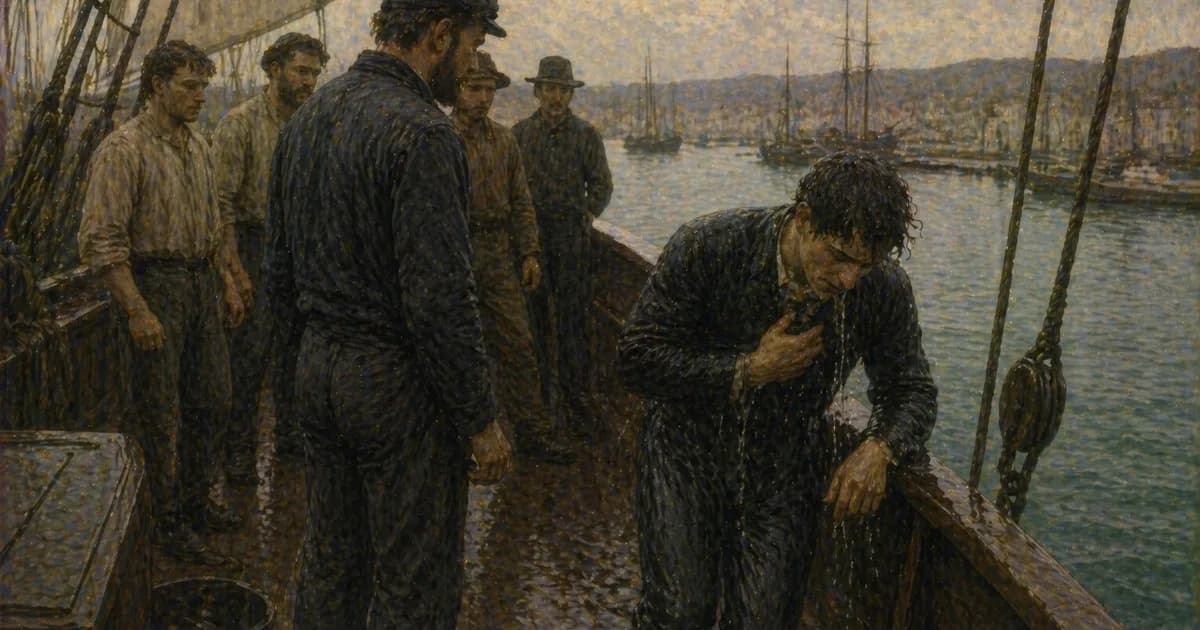
He stood at the deck at the larboard bow with the water at his hair and his coat and his trousers and his shoes.
Pallesen said he was up. Olav said yes. The boatswain looked at him for a moment with the look of a boatswain who had pulled a man from a harbor at fifteen degrees north on a morning tide and was deciding whether to set him to the dry-out or to the work, and said the dry-out. Olav went below to the forecastle with his hand at the breast-pocket.
He took the letter out of the breast-pocket at the bunk.
The letter was wet at the edges. The wax at the seal had held. The three pages at the inside were wet at the edges where the breast-pocket had taken the water. The writing at the center of the pages was the writing Olava had written at the writing-table at the upper room at Lindøy on the sixteenth of March 1877, and the answer at the middle of the third page was the answer at the middle of the third page. The line at the lower edge of the third page where she had written about the long blue light at the small upper window of her room at Lindøy had bled with the water and was now a small grey shape at the page that did not give him the words. He laid the letter at the ledge at the side of the bunk where the air at the forecastle would dry it.
He changed his shirt and his trousers.
He went up to the deck. The boatswain set him to the dry-out work at the foredeck, which was the work of a man who had been pulled from the harbor and was at the foredeck working until his clothes were the clothes of a man at the foredeck again. Olav worked. The boatswain came forward at the four bells and looked at him and said he would do. Olav said yes.
The Dronningen sailed for Jamaica at the noon tide of the sixth day.
The pilot took her out of the inner harbor under topsails. The trade was at northeast at twelve knots, and the bark went down to the open Atlantic at six knots with the trade on her quarter, and the brown island of São Vicente fell behind at the larboard quarter. Olav was at the foremast pin-rail. He had the letter at the breast-pocket inside the dry coat that he had laid at the chest after the morning's dry-out and had put on again at the change of the watch.
Bertel came up to the pin-rail at the third bell of the afternoon watch and laid a coil at the cat-falls in the figure-eight beside Olav. Bertel said the trade would hold for the run to the Caribbean. Olav said yes.
The bark went down to fourteen north and turned west at the noon of the third day, and the trade carried her west across the long run to the latitude of Jamaica.