
The letter from Bristol came to Lindøy on the Wednesday of the second week of March in 1877.
Bjørn had been at Stavanger from the Monday until the Wednesday morning, and he had come back on the Wednesday boat at noon with the canvas bag he took to the Helland office at Stavanger when he went, and the bag had four letters in it and the receipt for the boat-line of nets the Helland office had got in for him, and one of the four letters had the writing-paper of a Bristol stationer at the outside and the inscription in three lines that Olava read at her father's hand at the kitchen table at half past one on the Wednesday afternoon.
She read the inscription twice.
The inscription said: To Olava Lindøy of Lindøy, in the parish of Hetland, by way of Bjørn Olsen Lindøy at Lindøy by way of John Stensøy at Stavanger. She had been waiting for this letter since the Christmas before this. She did not open it at the table. She put the letter at her apron-pocket and went up to the small upper room at the second floor of the house, which was the room she had slept in since she was twelve, and she sat on the bed and she opened the letter at the bed.
She read the letter through once.
Then she read it through again.
The letter was four pages on the back and the front. The first three pages were the run from Wilmington and the hurricane the Dronningen had come through at thirty-eight north and thirty-five west, and the carpenter Bertel and his wife at Tau, and the boy Erling at his first hurricane, and Old Man James at Marsh Street, and the long blue light at her own small upper window at Lindøy that she had told him about in the letter she had written him in November.
The fourth page had the question on its own line in the middle of the page, in a single sentence in the plain Norwegian a young man of nineteen at a Bristol boardinghouse-table on the eighth of February 1877 had written to a young woman of nineteen at Lindøy: Olava—will you have me as your husband when I come home from this voyage.
There was no question-mark at the end of the line.
Olava looked at the line for some minutes. She looked at the full stop after the word voyage that was a small black mark at the page that did not press at her. She read the line a third time. She read it a fourth time. She did not yet know what she would say. She had thought she would know, on the day the letter came, what she would say. She did not know.
She read the rest of the letter under the line. The answer was to go to Cape Verde by way of the Helland office at Stavanger. He would carry it at his coat-pocket from Cape Verde to wherever the Dronningen went after, whether it was the answer he was asking for or the other answer. He had signed the letter Olav Hestby of Vestbø.
She folded the letter at the bed and put it at her apron-pocket. She sat at the bed for some minutes with the apron-pocket flat at her hand. The light at the small upper window at two o'clock on the Wednesday afternoon of the second week of March was the light of a March day that had not yet decided whether the rain would come. She looked at the light at the window. She looked at the wooden chest at the foot of the bed where she had kept the photograph of Olav from the studio at Pedersgate since July. The photograph was at the chest. She did not take it out.
She went down the stairs to her mother.
Bertha was at the kitchen with the bread for the Wednesday baking. The flour was at the wooden trough at the side of the table. Bertha looked up when Olava came in. Olava said the letter from Bristol had asked her if she would be his wife. Bertha received it with a nod. She said the saying-yes was a thing one did at one's own time, and that there was no day that had to be the day. Olava said she had not yet decided. Bertha said the not-yet-deciding was the right place to be at two o'clock on the day the letter came, and that the deciding was a thing that often took the walking of a path before it came up at the next place. Olava said yes.
Bjørn came in from the boat-house at three.
Olava said the letter had come and that it had been the letter she had thought it would be and that she had not yet given the answer. Bjørn listened. Bjørn said the youngman from Vestbø was a youngman whose father was the man Bjørn had known to be the man at Vestbø since 1845, and that whatever Olava decided would be a deciding her father would stand at. Olava said yes. Bjørn went to the writing-desk at the wall and put the receipt for the boat-line of nets at the box and went out again to the boat-house.
Gustav was at Lindøy that week between two voyages, and he had been at the upper field at one o'clock when the boat had come in with Bjørn, and he came down to the kitchen at half past three and took bread from the loaf Bertha had set on the cooling-rack. He saw the apron-pocket flat at Olava's hand. He said the youngman from Vestbø had written from Bristol. Olava said yes. Gustav said the youngman had written what Gustav had thought the youngman would write at Bristol. Olava did not say yes. Gustav said the answer was Olava's answer and not Gustav's, and he said it without the teasing he had used at Rossøygate in July. The brother who was at Lindøy this March between voyages had seen that this Wednesday afternoon was not the afternoon for the Rossøygate kind of teasing. He took the bread to the upper field.
Bertha said she would walk to Rossøy in the morning if Olava wanted to walk with her.
Olava said yes.
The path from Lindøy to the chapel at Rossøy was a path Olava had walked since she was eleven. The path went from the gaard at Lindøy down to the landing at the south side of the island, and the landing had a boat at the post that the Lindøy and Rossøy households kept between them for the crossings, and Bertha and Olava took the boat at half past nine on the Thursday morning and Gustav rowed it across the narrows between Lindøy and Rossøy. He did not ask what the morning was for. He had been at the kitchen at the supper on the Wednesday evening when Bertha had said about the walk and had not asked. The crossing was three-quarters of a mile of quiet water at the south side of the islands, and the wind on the Thursday morning was at the southeast at four knots, and the sun was through the high cloud at an angle that put the light of late winter on the grass at the upper end of the Rossøy landing.
Gustav said he would be at the landing at four with the boat.
Bertha and Olava walked up from the landing to the path that ran along the upper side of Rossøy to the chapel. The path was a path of stones laid in the gorse, and the gorse on the Thursday of the second week of March was not yet in flower because the gorse at Rossøy did not flower until April, but the buds were showing. They walked at the pace Bertha set, which was the pace of a woman of fifty who had walked the path since she was a girl. They did not speak for the first quarter of a mile.
Then Bertha said she had walked the path with Jens Hestby and Olav's mother in the year before her marriage. Olava listened.
Bertha said Olav's mother had worn a yellow ribbon at her hair that day, and the ribbon had been the color of the gorse at the side of the path, and Olav's mother had sung the four hymns at the chapel that morning because the minister had not had a singer that summer. Olava said yes. Bertha said she had thought, hearing the voice from the back of the chapel where she had sat with her mother, that the voice had been a Rossøy voice and not a Finnøy voice. Olava said she could hear that. Bertha said the woman who had sung the four hymns had married Jens at Hesby church in the years after the walk, and the woman had been Olav's mother for nine years before she had died at the spring of 1867, and Olava had not known her. Olava said no. Bertha said the woman was a woman Olava would have liked to know.
Olava said yes.
Bertha said she had walked the path because the path had been a thing she had walked when she had been a young woman deciding a thing, and that the path was good for the deciding because it was at Rossøy and not at Lindøy. Olava said yes. Bertha said she would walk on alone for a few minutes if Olava wanted to walk on alone too. Olava said she would.
The path divided at the wooden gate at the upper bend, and Bertha went on toward the chapel at the upper end of the path and Olava went down the small fork that ran along the upper side of the bay at the southwest corner of the island, where the path came out at the headland above the bay and looked back across the narrows to Lindøy.
She stood at the headland.
She had walked the fork in the year of her brother's death. She had walked it in the months after his death, when the sitting at the bedside in the back room at Lindøy with the lamp turned low had been what a sister of seventeen did at the bedside of her oldest brother in his last illness. She had walked the fork because it was the place where the bay below the headland lay open, and the long water at the narrows ran out under the wind, and the chapel was where it had always been at the upper end of the path. The fork did not have to do any of the work the bedside had done. It was the place she had gone to when the bedside had been done and the months after had begun.
She stood at the headland for some minutes.
She thought about the youngman from Vestbø. She thought about the courtyard at Landa in June 1876 where she had put her hand at his arm and said the four words she had decided to say. She thought about the ravine on the road to Roda where she had asked him whether there had been anyone at the Asta who was something other than the captain and he had said yes. She thought about the Saturday at Pedersgate and the dinner at Rossøygate and the cobbles at Bethania where she had said goodnight to him at the corner. She thought about the Dronningen sailing for Archangel in the August after, and the letter she had written him in November and sent to Wilmington, and the long blue light at her small upper window that she had told him about in the letter. She thought about the letter at her apron-pocket that had come to Lindøy yesterday.
She had not been a person who had been written to in this way before.
She was nineteen, and she had been, in the nine months since the courtyard at Landa, the woman she had been deciding to be. She had decided it slowly. She had decided it from several sides, in the way her mother decided things. She had not decided it because the youngman had asked her. She had decided it before the asking and the asking had come at the place the asking came at, and the answering she would do now would be the answering of the woman she had been deciding to be.
She thought, at the headland, that the answering had come to its place.
She stood at the headland a while longer, because the headland was a place to stand at while a thing was being said for the first time without speaking. The wind at the southeast had come round to the south-southeast at six knots. The bay below the headland was a bay of late winter that was beginning to show, in the small ways a bay of late winter shows, that the spring would come at its time. The cloud had thinned and the sun was at the upper third of its winter angle. She looked at the bay. She looked at Lindøy across the narrows. She looked at the path back toward the chapel where her mother had walked on alone, which was a path her mother had walked when she had been deciding a thing, and her mother had decided that thing in the year before her marriage to Bjørn Olsen of Lindøy, and her mother had been twenty.
She walked back along the small fork to the wooden gate.
Bertha was at the gate at the noon. She did not ask. She looked at her once and they walked together back down the path to the landing, and Gustav was at the landing at four as he had said, and the boat went back across the narrows with the light of the late winter afternoon on the south side of Lindøy.
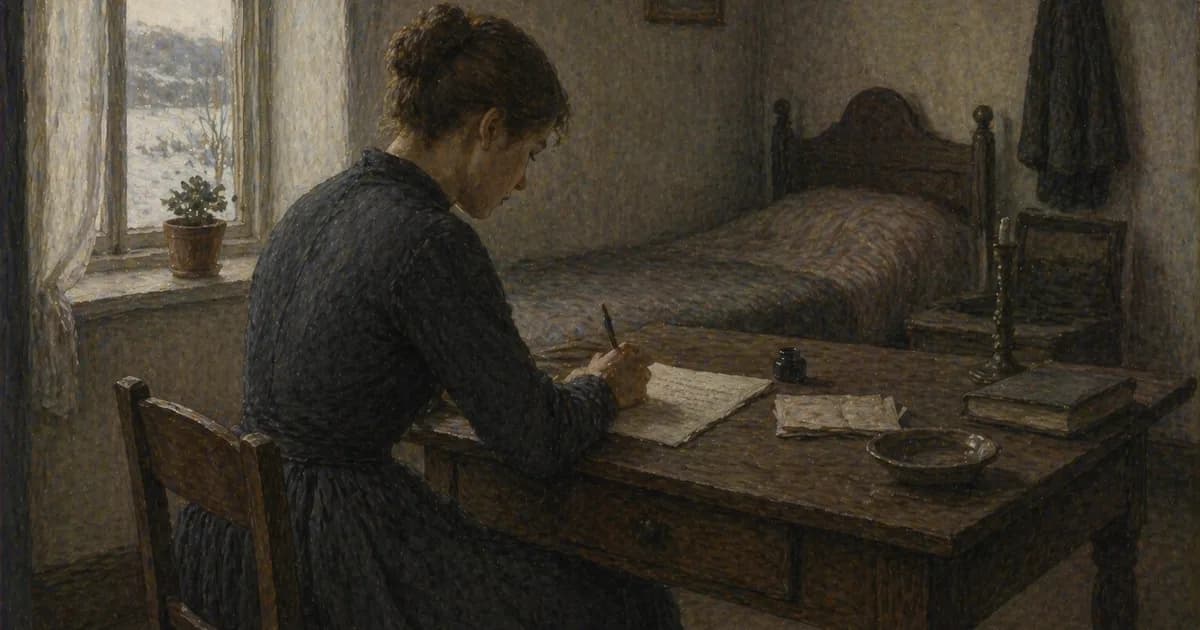
Olava sat at the writing-table in the upper room at Lindøy on the Friday morning at the noon hour with the writing-paper Bertha had brought from Stavanger in the canvas bag at Karoline's at Rossøygate two weeks before, and she wrote the answer.
She wrote it slowly.
She wrote the inscription at the top of the page, which was three lines: To Olav Hestby of Vestbø, by way of the Helland office at Stavanger to Cape Verde. She wrote the date at the upper right of the page in the Norwegian numerals she had been writing since her confirmation, and the date was the sixteenth day of March in the year 1877. She looked at the date for a moment and she thought about the date he had written at his letter, which had been the eighth of February, and the five weeks between his date and her date were the time the letter from Bristol had taken to come to Lindøy and that her letter from Lindøy would take to find him at Cape Verde or at wherever else the Dronningen was when the Helland office's forwarding caught up with her.
She wrote the body of the letter under the date.
She wrote that the letter from Bristol had come on the Wednesday of the second week of March and that her father had brought it from Stavanger at the noon boat. She wrote that she had walked to the chapel at Rossøy on the Thursday morning with her mother and that the chapel was the chapel her mother had walked to with Jens Hestby and Olav's mother in the year before her mother's marriage. She wrote about the gorse at the path that was not yet in flower but that would flower in April. She wrote that her father had said the youngman from Vestbø was a youngman whose father was the man Bjørn had known to be the man at Vestbø since 1845, and that her brother Gustav had said the answer was Olava's answer.
She wrote the answer on its own line in the middle of the page.
She wrote it in a single sentence in the plain Norwegian a young woman of nineteen at a writing-table at Lindøy on the sixteenth of March 1877 wrote to a young man of nineteen at sea: Olav—yes, I will have you as my husband when you come home from this voyage.
She did not write a question-mark at the end either. She had not been going to. She wrote a full stop after the word voyage and looked at the line for some minutes, and then she wrote the rest of the letter under the line.
She wrote that she would be at Lindøy waiting for the Dronningen at the Stavanger wharf when the Dronningen came home, and that she would write him at every port the Helland office would forward to, and that she would think of him at the long blue light of her small upper window at Lindøy on the evenings when the light at the window was the light he had written about. She signed the letter Olava Lindøy of Lindøy.
She folded it. She sealed it with red wax her mother had brought from Stavanger. She addressed the outside in the three-line inscription she had written at the top of the page.
She took the letter down to her father at the boat-house.
Bjørn looked at it once. Bjørn said John Stensøy would be at Lindøy on the Saturday afternoon for the flounder he had said he would come for, and that John Stensøy would take the letter back to the Helland office on the Saturday evening, and the letter would go on the Aurora of Stavanger that was leaving for the south on the Tuesday tide with the spring agents' run. Olava said that was good. Bjørn put the letter at the chest at the side of the writing-desk at the boat-house, where the letters going out from Lindøy waited for the boat that would take them.
John Stensøy came on the Saturday afternoon for the flounder. He took the letter when he took the flounder. He said it would go on the Aurora on the Tuesday. Olava said yes.
The Aurora of Stavanger left Stavanger at the morning tide of the Tuesday with the spring agents' run for the south.
The letter was at her bag.