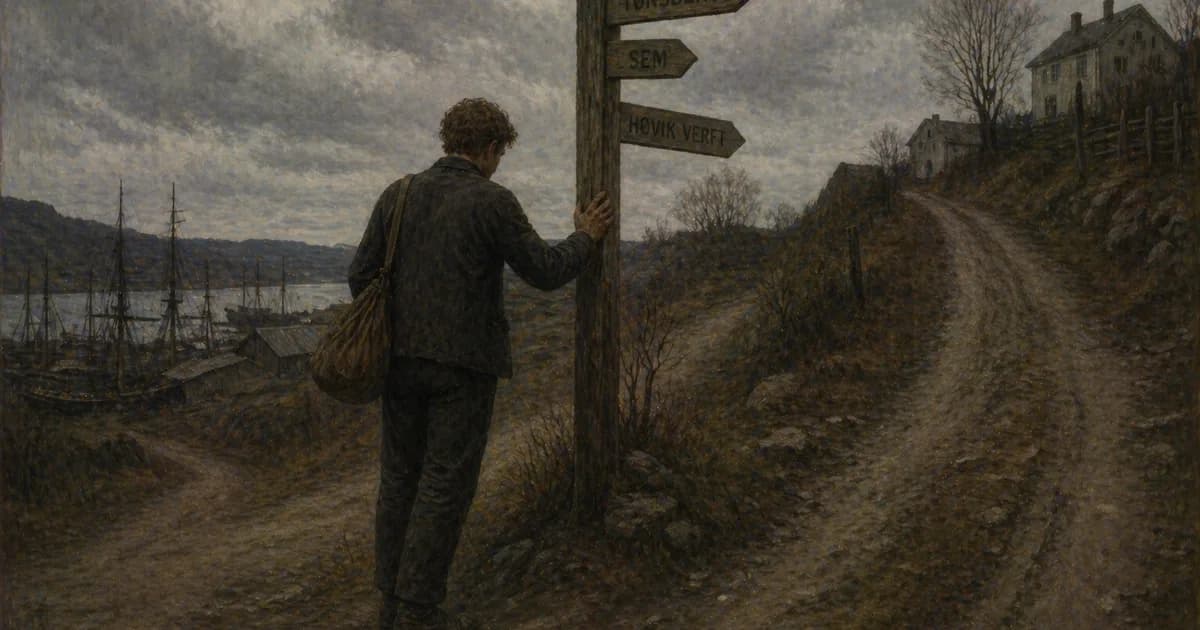

He walked the road from the staithes inland past a row of houses where the smoke from the chimneys had the color of old iron and the doors stood open on the side that gave onto the river. A woman at the third door was beating a rug against the doorframe and did not look up at him. A dog at the fifth door looked up and decided he was not a thing the dog needed to bark at. The road bent at the end of the row and climbed a low rise toward Hebburn town, and at the bend a smaller road turned down to the right toward the slips. The smaller road had a wooden sign at the corner with the names of the yards on it. Rutherford & Co. was the third name from the top, in letters that had been black and were now grey.
He did not take the smaller road.
He stood at the corner for a moment with his hand on the post of the sign and he looked down the smaller road at the river beyond and at the staging that began where the road ended. It was the staging he had seen across the water in October. The men on the staging were small at this distance and he could not make out, among them, the man who had spoken to him in October about a Norwegian sailor and a plank in 1856. He took his hand off the post. He went up the rise toward the town.
The town was three streets and a church and a market square that was not a market square that day because it was not market day. The shop-windows had bread, tobacco, tin pots. One window had a row of glass jars of preserved things that Olav could not name from the labels because the labels were in English. He walked past the windows. At the second corner of the second street there was a coffee-stand under an awning and a man behind the counter and three stools. Two of the stools had men on them. The third stool was empty.
He sat at the stool.
The man behind the counter said something Olav did not catch and Olav said "Coffee, please," in the English he had practiced at the Sigrid's forecastle in October with a man named Henrik who had spent a year at the herring stations. The man behind the counter nodded and turned to the urn and drew the coffee and set it down. The cup was a thick white cup with a chip on the rim that had been chipped a long time. The coffee was hotter than the coffee on the Asta had been on any morning of the voyage, and was good. He drank it slowly.
The man on the next stool was an older man in a coat that smelled of the river. He looked at Olav and he said something. Olav did not catch the sentence. He caught the word Norwegian and he caught the word boat and he caught a word at the end that might have been brother or might have been another. He did not know which it was. The man was waiting. Olav said "yes," because he did not know which question he had been asked and because "Yes" was an answer that closed a sentence with a stranger more cleanly than what did. The man on the stool nodded once and went back to his cup. He did not say anything else.
Olav drank the rest of his coffee.
He paid the man behind the counter with a coin he had been given by Lønning that morning at the rail, which was a coin Lønning had said was the right coin for the price of a coffee in Hebburn. The man behind the counter took the coin and gave back two smaller coins and said "Thank you." Olav said "Thank you" back. He stood up from the stool. The man on the next stool looked at him as he was standing and said one more thing that Olav also did not catch. Olav said "Yes" again, more quietly. Then he went out from under the awning.
The road back to the staithes ran past the same houses and past the same dog. The woman at the third door was no longer at the doorframe. The smoke from the chimneys had not changed. He came down the rise. The river had not changed. The Asta was where he had left her. He went up the gangway and he went forward to the forecastle. Pål was at the forecastle bench mending a strap. Sørli was in his bunk asleep with his arm across his face. Nils was not below.
The coal came aboard the next morning.
It came in barrows from the staithe, two men to a barrow, and was tipped into the hold through the hatchway forward, which had been opened and the planks set across the coamings and the canvas lifted away. The coal-dust came up the way it always came up—the color of a thunderhead, finer than dust had any business to be—and it settled on the deck and on the rail and on the men and on the canvas of the lifted hatch, and the men rinsed their faces at the wash-bucket at the end of every hour and the faces became less black and the bucket became more black with each rinse. The captain was ashore at the office of the agent. Lønning was at the hatch with the tally. By dusk on the second day the hold was full and the carpenter had set the planks back over the coamings and the canvas was lashed down. The captain came aboard at the change of the watch in his coat with a packet of papers under his arm and a man Olav had not seen before walking a half-step behind him. The man was a clerk from the agent's office, with a ledger he held against his chest with both hands. The captain went below to his cabin with the clerk and stayed there for the better part of an hour and came back up alone. The clerk had gone back over the side without anyone seeing him go.
The pilot came out at first light. He was a different pilot from the one who had brought the Asta up the river. He had a beard that was not grey and a coat that was new. He took the wheel from the captain and the captain stepped back to the wheel-box and stood with his hands behind him and the Asta came down the Tyne under topsails and a jib and dropped the pilot at the bar at half past nine, and by ten the Asta had her courses set and was running south on a soldier's wind into the open sea.
By the second day out the steward's locker was open again.
It was open quietly. The captain did not come up at four bells the way he had come up at four bells on the second day of the first leg. He came up later in the morning, at six bells, and he stood at the wheel-box with his hands at his sides instead of behind him, and Lønning gave the orders for the morning's work without going aft to the captain for them, and the captain did not say to Lønning that the orders had been given without him. The captain was at his place. Olav saw, in the place at the wheel-box where the captain stood, that the captain's coat was buttoned by one button on the wrong hole and that the wrongness of the button was a wrongness no man on the deck would speak about, which was the wrongness of the Asta now.
The wind held fair through the Channel. They sighted the Lizard on the morning of the fourth day at sea and were past it by noon, and by the morning of the fifth day they were standing well out into the Bay of Biscay with the French coast a low grey suggestion off the larboard quarter that Pål, who had been to Bordeaux in a Drammen brig the year Olav was born, named without being asked. Pål named places without being asked when the place was a place a man should know. He named the headland at Ushant the night before. He named the rock off Penmarc'h on the morning of the fifth day. He did not name the bottom of the Bay of Biscay because the bottom of the Bay of Biscay was not a place a man should know.
Haakon was at the foretop with Olav on the morning of the fifth day. They were not working the rigging; they were standing watch at the foreyard for a sail that the captain had not asked them to look for but that Lønning had asked them to look for, because Lønning had decided, without asking the captain, that a sail to leeward of them in the Bay of Biscay at this season was a thing that would do well to be seen as soon as it could be seen. Haakon stood with his hands on the topgallant-stay and looked south. Olav stood with his hands on the topsail-yard and looked east. Neither of them spoke for the better part of the hour. At the end of the hour Haakon said, "Nothing," and Olav said, "Nothing," and they came down the ratlines and Lønning was at the foot of the mast and Lønning said, "Nothing?" and they said, "Nothing," and Lønning nodded and went aft.
The wind backed into the south on the seventh day. The Asta came onto her starboard tack and beat against it for two days, making perhaps fifty miles a day to the south-southwest, with the Spanish coast off the larboard bow at a distance that did not change, and on the third day of the beat the wind moderated and came round to the west and the Asta squared away and ran south on a reach for the Portuguese coast.
She raised the rock off Cape St. Vincent on the morning of the twelfth day at sea. The rock stood out of the water at the southwest corner of Europe where the continent ended. Olav was at the deck when Pål called it down from the foremast head. He looked at the rock and at the long low coast that ran north from the rock toward the Tagus, and he saw that the coast was the color of bone in the morning sun and that the sun was the sun of a country he had never seen.
The Asta turned north along the coast for the run up to Lisbon. Tagus mouth was a day and a half away. The captain came up at six bells of the afternoon watch in his coat with the wrong button and stood at the wheel-box and looked at the coast and said something to Lønning that Olav, at the foremast pin-rail, did not hear over the wind.