
The pilot took the Asta up the Tagus on the morning of the fourteenth day at sea, with the river-fort showing white at the south side of the entrance and the white-tiled buildings of Lisbon climbing the hills on the north side from the water to the high ground above the city. The pilot was a Portuguese in a black coat with brass buttons and a white shirt that had been pressed at a place ashore that pressed pilots' shirts, and he stood at the wheel and gave his orders in an English that was not the English of Hebburn or the English of any place Olav had heard, but that the captain understood and that Lønning understood enough of, and the Asta came up the river under topsails and a jib at the slow walk of a deep-loaded ship coming into a harbor she did not know. The hills of Lisbon rose white above the river and the bells of a church Olav could not see were ringing for a service that was not the Lutheran service of any morning he could remember and that was not, by the sound of them, the bells of any service at all but the bells of a place that rang its bells for the hours and not for the souls. The Asta came to her anchor at half past eleven off a long wharf on the north shore where four other ships were already lying, and the captain went ashore in the boat with the pilot at noon and did not come back until the sun was halfway down the western sky.
Olav was at the deck for most of the afternoon. The deck-work at anchor in a foreign harbor with the cargo not yet broached and the crew waiting for the agent's papers was cleaning what could be cleaned, overhauling what could be overhauled, standing the watch the harbor required. He worked at the foremast pin-rail with Sørli for the first half of the afternoon, and at the mainmast with Pål for the second half, and he looked, between the orders, at the city across the water—at the white buildings climbing the hills, at the small boats with brown sails crossing the river between the Asta and the wharf, at the figurehead under the Asta's bowsprit which sat now in the southern sun the way it had sat in the northern sun off Norway and which had not changed though everything around it had. The sun on the deck was warmer than at any point since the Asta had cleared Tungenes. A man in oilskins at noon would have been a man in oilskins by mistake. Olav had taken his oilskin off at eight bells of the morning watch and had hung it in the locker forward of the forecastle scuttle, and the locker was a different locker for him now than it had been when the only man's coat in it had been the coat of the dead Tønnesen.
Haakon came forward at four bells of the afternoon and stood for a moment at the pin-rail beside Olav. He did not give an order. He looked across the water at the wharf where the captain's boat was returning, and at the man in the long coat and the wide hat who was sitting in the stern of the boat beside the captain. He said, "We will be at this anchor longer than the captain told the agent we would be at it." Olav did not ask how Haakon knew. Haakon was the boatswain who knew when an anchor was set for a stay longer than the captain had named, in the way he knew which of the lines on the foremast pin-rail had taken a set and which had not. Haakon went aft. The captain came back at four o'clock with a man Olav had not seen before, in a long coat and a wide hat, who stayed with the captain in his cabin for half an hour and then went back over the side. Then the captain came up onto the deck and crossed to the foremast pin-rail where Olav was working at a fresh coil and said that Olav and Nils would come ashore with him at six bells of the afternoon watch to carry a packet of papers to the shipping office on a street called the Rua dos Fanqueiros and to wait there until the office had stamped the papers and to bring the papers back. The captain said this in his coat with the wrong button, which Olav had not looked at since the morning at the Tagus mouth and which was still buttoned by one button on the wrong hole.
Olav and Nils went ashore with the captain at three o'clock. They went up in the captain's boat with two men of the crew at the oars who would bring the boat back. The captain was sober. He had been sober at noon when he went ashore the first time and he was sober now at three when he went ashore the second time, which was a thing Lønning had remarked on in his quiet voice to the steward at a moment Olav had passed the after hatch, and the steward had not answered, and Lønning had not gone on. The boat made the wharf at twenty past three. The captain stepped out onto the stones of the wharf and Olav and Nils stepped out behind him and the boat went back to the Asta with the two men at the oars.
The captain led them up from the wharf into the streets of the lower city. The streets were paved with white stones and black stones in a pattern of lines and squares, and at the center of one square was an inlaid star of black stones in the white, perhaps eight feet across, that Olav looked at without slowing because the captain was walking at a pace that did not allow for looking. A line of mules came down the street they were going up, each mule with a basket on each side full of green vegetables that smelled of a place that grew vegetables in March, and the muleteer at the head of the line raised his hand to the captain in the way a man raises his hand to a man he does not know but understands to be foreign and not to be in his way, and the captain did not raise his hand back. They climbed three streets and turned at the fourth onto the Rua dos Fanqueiros, which was a street of tall houses with shops at the ground floor and balconies above the shops with washing on the balconies, and at the third house on the right was a door with a brass plate and a name on the plate Olav could not read. The captain handed Nils the packet of papers. He told Nils to wait inside. He told Olav to wait at the door. He went in himself. He did not come out.
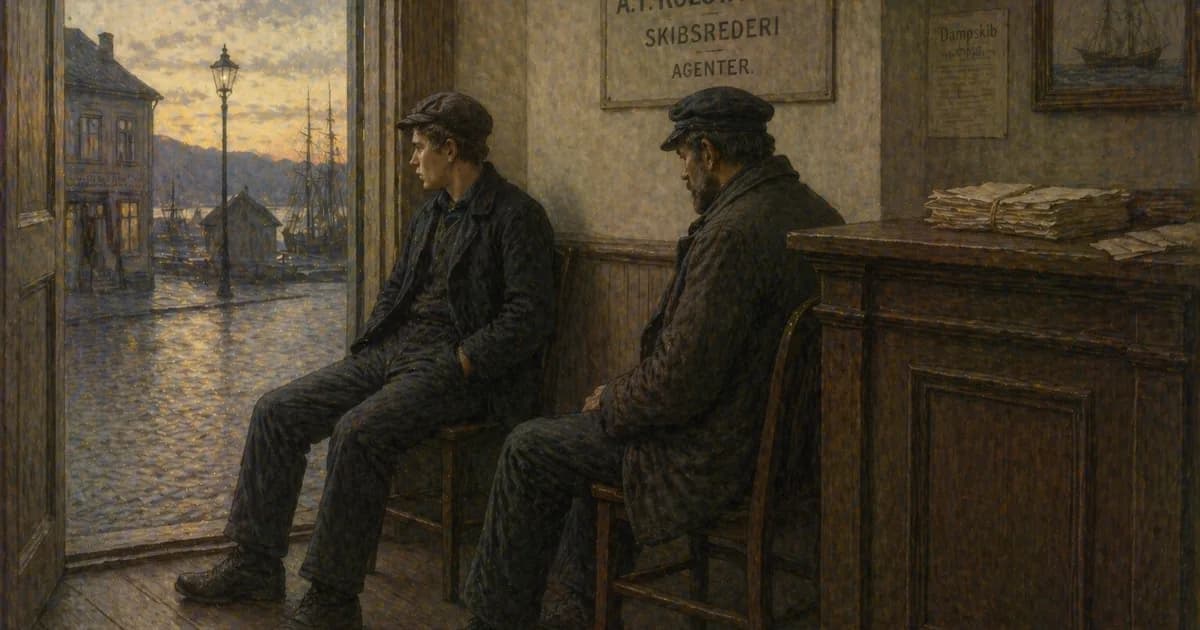
The afternoon went on. Olav stood at the door for the first hour and Nils sat inside on a wooden bench in a small front room where a clerk in a green waistcoat looked at the packet of papers and said something Nils did not understand and set the packet aside on a high desk and went on with his own work without looking at Nils again. The captain had gone through the second door inside the front room and had not come back through it. After the first hour Olav went inside and sat beside Nils on the bench. After the second hour the clerk in the green waistcoat went out through the second door himself, with a bundle under his arm, and did not return. The packet of papers sat on the high desk. There was no one in the room. Olav and Nils sat on the bench. Outside, in the square at the end of the Rua dos Fanqueiros, a man was selling cooked chestnuts at a brazier and the smell came in through the open door and into the front room, and Olav had not eaten since seven in the morning and Nils had not eaten since seven either, and they had no money between them because the captain had not given them money and the captain had said nothing about chestnuts.
The light at the doorway moved across the floorboards in the slow way light moves across a floor in a room a man has not chosen to be in. Nils sat with his hands flat on his knees in the way Eliasson had sat with his hands flat on the wood of the forecastle table, which was a way of sitting Olav had not noticed in a man before he had seen Eliasson do it and had now noticed in a second man. He did not say to Nils that he had noticed it. He looked at the high desk and at the packet of papers on the high desk and at the door the captain had gone through and had not come back through. There was a clock on the wall above the high desk that had stopped, the way clocks stop in rooms where no one is responsible for winding them, and the hands stood at twenty past four, which was the time the captain had gone through the door, and which was, for the clock, the only time there now was.
By dusk the captain had not come back. Olav went out into the street and looked up the Rua dos Fanqueiros and down it and saw no one he recognized. He went to the corner and looked at the square and saw the chestnut-man closing his brazier for the day. He came back to the door of the office. Nils was still on the bench. The packet of papers was still on the high desk. Olav sat down on the bench beside Nils. They sat for another hour.
"He will not come back tonight," Nils said.
"He may," Olav said.
"He will not," Nils said. "I have seen him do this before."
"On the Elida?"
"My brother sailed in the Elida," Nils said. "I have heard about it from him."
Olav did not ask what else Nils's brother had told him about the captain. He did not need to ask. He stood up. He went to the high desk and took the packet of papers down from it, because the packet was the only thing he had been told to bring back and he could think of no good reason to leave it where the captain had left it. He put the packet inside his coat. They went out from the office. They walked down the Rua dos Fanqueiros and through the streets of the lower city to the wharf, and the wharf was empty of all but a few small boats, and the Asta was at her anchor a quarter of a mile out into the river under her riding-light, and the boat that had brought them ashore was at her side and was not coming back across.
They paid a Portuguese boatman with a coin Nils had in his pocket from a transaction Olav did not ask about, and the boatman took them out across the river in the dark to the Asta. The water was the color of the city's lights upside down. The figurehead under the bowsprit was not visible in the dark but Olav knew where it was. They came alongside at twenty minutes past ten by the chime of a clock on the shore that struck the half-hour as they went up the rope-ladder over the rail, and Lønning was at the rail to meet them, and Lønning looked at the packet of papers Olav had under his coat and did not ask anything about it.
The hail came an hour later from the river.
It came in the captain's voice, calling the ship's name. Asta. Asta, ahoy. It was the captain's voice, four hours past where it had been at noon, and Lønning, who had the deck, answered like a man who had heard it before. The captain came up over the side from a ferryman's boat at the larboard mid-section of the rail, with the ferryman behind him not coming aboard. The captain came onto the deck. He looked at Lønning and he asked where the boys were. Lønning said they were below. The captain went forward to the half-deck and called for them.
Nils came up from the forecastle.
What happened then happened in the small open space between the half-deck and the foremast, in the light of the riding-lamp at the bow and the light of the lamp at the after bulkhead, and was the sort of thing that happens in the small open spaces of ships at anchor when the captain has had four hours of his wine and a boy of the crew has done a thing the captain did not specifically tell him to do. The captain struck Nils in the face with his closed fist twice, once on the side of the jaw and once on the same place above the cheek where the bruise from the North Sea morning had only just gone yellow at the edges. Nils did not raise his hands. The captain knocked him down. He kicked him in the ribs and he kicked him a second time in the place where a man's thigh meets his hip, which was the place the captain had kicked him before, and he kicked him a third time in the back of the head when Nils had rolled to keep his ribs away from the boot, and Nils did not move after the third kick. The captain stood over him for a moment. Then the captain went aft, and went below, and shut the door of his cabin.
Lønning came forward with Pål and they lifted Nils. Pål carried him by the shoulders and Lønning by the legs and they took him below to the forecastle and put him in the bunk that had been Eliasson's for the months before this voyage and that was the empty bunk now. The steward came forward with a basin of water and a cloth. Pål went back up to the deck. Lønning stood at the bunk for a moment looking at Nils. Then Lønning said to Olav, who had come down from the deck behind them and was at the doorway, "Sleep above. Not below."
"Sir."
"Take this." He took a marlinspike off the rack at the bulkhead and put it in Olav's hand.
Olav took the marlinspike and went up. He did not go to the forecastle bunk that had been his since Stavanger. He went aft to the mainmast, and from the mainmast to the mizzen ratlines, and up the mizzen to the topgallant-stay, and out along the topgallant-stay to a place he had noticed the morning of the arrival without knowing why he was noticing it, where the line of the topgallant-stay met the spider-band at the mizzen-mast and where the rigging of the mizzen made a small dark cradle that could not be seen from the deck. He sat in the cradle. He put the marlinspike across his knees. He could see, from where he sat, the lights of Lisbon climbing the hills on the north side and the dark of the south side and the river between, and the deck of the Asta below him in the riding-lamp's light, and the closed door of the captain's cabin under the quarterdeck.
The lights of Lisbon were not the lights of any city Olav had seen. The lights of Stavanger came on at the harbor and along the inner streets and were the color of lamp-oil burning in glass that had been wiped at the start of the evening by a hand that took pride in the wiping. The lights of Hebburn had been the color of coal-gas at the high street and of lamp-oil at the side streets and of nothing at the staithes, where the only light was the lamp at the watchman's hut. The lights of Lisbon were not gas and were not lamp-oil, and were yellow at some streets and white at others and orange at the doors of buildings he could not name, and they climbed the hills the way men with lamps in their hands climb a hill in the dark. He watched them for a long time. He could hear, faintly, music from a building near the wharf, and the music was not music of any country he could name either.
The captain had a wife two thousand miles away who had said small things at her own table in March about where a spoon lay and whether a glass was full, and Olav sat in the mizzen rigging above the deck of the Asta in the night of his first day at Lisbon and thought about her without thinking about her, the way a man thinks about a thing he is not going to do anything about but cannot stop registering. The wife at the Stavanger table had not said about the captain that he beat youngmen with his closed fist and kicked them in the place where a man's thigh met his hip. She had not needed to say it. She had cut into the silence after a sentence that had half-finished and had said that the pudding had gone round, and the captain had laughed, and John Stensøy had laughed, and Jens had not laughed.
He did not sleep. He kept the marlinspike across his knees through the four hours of the middle watch and the four hours of the morning watch. He came down at first light. Nils was alive in the bunk that had been Eliasson's, and the captain did not come up at four bells.